Interior Design Software – Should You & Which is Best for You?

If you're not familiar with the website TopTenReviews.com, you might want to take a look. They post reviews for products of every description: from electronics to health and beauty, and from hobbies to home and garden. Among the digital products they examine, they also have a page of reviews on interior design software, which is what concerns us.

From Best Overall to Best Value, Best for Mac, and Best for Small Projects, they rank the software as “the best programs for designing interiors, ranked by their ease-of-use, the size of their object libraries and their import/export features.”

Not only does the site offer reviews of individual design software programs, they also present their finding in a table that makes it easy for you to consider their features and benefits relative to the others (as shown in the partial screen shot below).
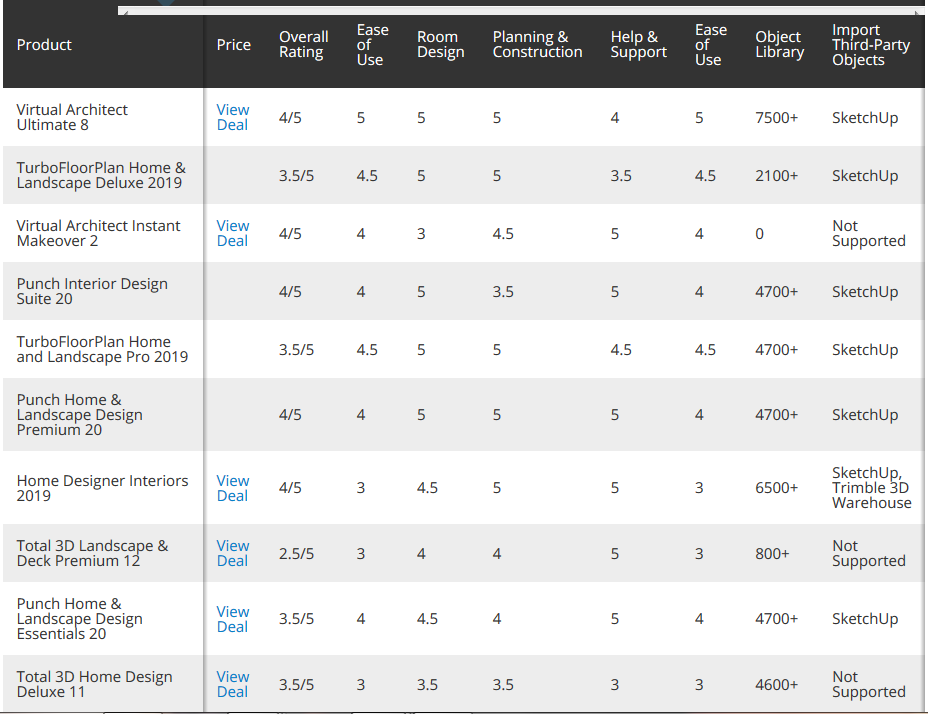
interior design software.png

We should probably throw in a cautionary warning here that the name of the software may not be indicative of how effective the program is as an interior design tool. In a world where so many try to be all things to all people, that may be a simple marketing choice on the part of the manufacturer.

Instead, read the reviews and take a test drive of the software (where possible), before making a purchasing decision.

Having said all of that, let’s look at a few interior design software programs and the parameters for ranking them.

Interior Design Software Reviews

First, the ranking parameters used by the reviewers:

  • Ease of use and learning curve

  • Object library and object import functions

  • Cost estimator and material sheets

  • Available for both PC and Mac

  • Sample plans available

  • Cost and support

Understandably, learning how to use the software is one of the most important features for the reviewers, as was ease of use when designing a space. Design flexibility and the size of their object library are also important features since they are huge time savers. Ultimately, execution is critical; the way in which the software performs the featured functions as well as doing so intuitively.

design software ease of use.png

Best Overall Rank: Virtual Architect Ultimate ($99.99)

“The primary reason our reviewers chose Virtual Architect Ultimate as their top pick is it’s extraordinarily easy to learn to use, even if you’ve never used design software before. Its exhaustive array of design tools allow you to drag and drop objects where you want them, import photos and floor plans, and add furniture, plants, appliances, electronics and more.

“[The] object library contains more than 7,500 items – the largest library of any interior design program we reviewed. In case you can’t find what you’re looking for in Virtual Architect Ultimate’s library, you have a couple options. It is compatible with the SketchUp database, which houses literally thousands more objects, including furniture, lighting, appliances and more. You can also design custom objects yourself. The software has designer tools for things like cabinets, fireplaces, windows and stairs. All in all, it’s one of the most versatile interior design programs we’ve ever reviewed.

“In addition, the application has other useful tools, including a cost estimator and a materials list. Together, these two features give you a good idea of what it will take to bring your design from the digital world into the physical world. You can also export your finished designs in DXF and DWG formats, which are used by architects and contractors.”

design software learning curve.jpg

Best Value Rank: TurboFloorPlan Home & Landscape Deluxe ($49.99)

For those who don’t need every top-of-the-line feature… “It’s about $50 less than our top choice and includes many of the same design tools. It has essentials like moldings, window coverings and a preprogrammed object library (4,700+ items) as well as custom designers. They’re not as intuitive or comprehensive as those in other programs we reviewed but still more than enough to meet the needs of most users.

“However, you can’t import floor plans made with other professional design programs, trace floor plans, generate material lists, or export your plans in DXF or DWG file formats. Still, while these tools are very useful, they’re not essential to designing a home.

“This software is a bit harder to learn to use than the best programs. In our ease of use tests, TurboFloorPlan Home & Landscape Deluxe earned a B grade. It’s by no means impossible for a novice to master, but you should expect a slight learning curve before you can use it to its fullest potential. If you have any problems using the application’s tools, you can always check out its video tutorials.”

design software cost.png

Best for Small Design Projects Rank: Virtual Architect Instant Makeover 2.0 ($24.99)

Virtual Architect Instant Makeover 2.0 is “a unique interior design program. It lets you design directly on a photo of a room but is limited if you plan to reconstruct your living space.

“It has essential tools, such as window and door designers, and you can import existing floor plans and images into the software. In addition, it has nine sample plans you can use as jumping off points and a cost estimator that can give you an idea of how much it will cost to realize your plans in the real world. However, it’s missing advanced tools such as an object library and third-party object library compatibility. Also, you can’t export your plans as DWX or DWG files, the formats used by professional interior designers.”

While we would never presume to endorse or promote any of these interior design software programs as the “best” for you to use in your business, we do hope that the information shared from an outside source is helpful. Then too, more research and asking friends and associates in the industry for their opinions will go a very long way toward helping you decide on the best software program for you.

Looking for more interior design tips, design trends, marketing tips, new products, and furnishing ideas? Get in touch with TD Fall today.
Two Components of Interior Design – Lifestyle and Value

components of interior design.jpg

In a previous post, we discussed how the 7 elements of interior design must be used to enhance the fundamental components of design: function and aesthetics. Here, we would like to discuss two more components of interior design: lifestyle and value.

BTW… The purpose of these posts is not to merely state the obvious or to make anyone question their purpose or commitment to interior design. Rather, it is our hope that posts like these will help designers keep the concepts top of mind when working with their clients, promoting increased engagement and making their relationships stronger.

Once again we refer to an article at Medium.com, titled The Importance of Interior Design.

“Good interior design helps to create a living space that is both functional and aesthetically appealing using some of the latest design techniques. Hence, you cannot downplay its importance when planning the construction of a commercial or residential building. Many who have neglected interior design eventually regretted it after they started using their building and they had to engage in costly reconstruction. Here are some of the factors that underscore the importance of modern interior design.”

Matching and Promoting the Occupants’ Lifestyle

“The designs made by professional home designers will always suit the lifestyle of the homeowner. This is very important because it is not always easy to determine if an architectural design suits your lifestyle until you start living inside the completed building.

“Working with a designer, before you begin construction, will enable you to make critical changes that could be very costly after construction. For instance, lifestyle adjustments in interior design could include separating your toilet from the rest of the bathroom or reducing the size of your living room so that you can have a home office where you will spend more of your spare time.”

The Value Bonus of Interior Design

“The value provided by a good interior design leads to substantial cost savings in the long term. An interior designer is usually conversant with all the types of fixtures, lighting, drapes, paint, sofa designs, and carpeting that you should put in various parts of a house. However, some homeowners who feel that they can save money by avoiding the service of an interior designer sometimes spend more than a year trying to figure out what to install and how to install it correctly.

“Furthermore, a good interior designer will help you to save cost by providing the best materials, fittings, and furniture that you can afford with your current budget. This will help you to avoid costly renovations and remodeling shortly after you move into your new home.”

During a preliminary client interview, a sharp designer will focus on the benefits of working with them: enhanced functionality, efficient use of space, stunning aesthetics, and value are just some of the factors that demonstrate the importance of working with a good interior designer.

Looking for more interior design tips, design trends, marketing tips, new products, and furnishing ideas? Get in touch with TD Fall today.

Elements of Interior Design – Function or Aesthetics, Chicken or Egg

elements of interior design.jpg

It should be hoped that we can all agree there are 7 elements of interior design, including: space, line, forms, light, color, texture and pattern. We can also hope that keeping these elements balanced is the key to creating an aesthetically pleasing and functional interior, for home or office.

Yet, despite agreements about the elements of interior design, the purpose of interior design is too often ignored. After all, a good designer hopes that their clients are not merely trying to impress the neighbors, but rather, that they are hoping to improve their quality of life.

With that in mind, the purpose of interior design is to ensure that a living space or office will fulfill its purpose; that is, to ensure a home is livable and that an office is a good place to work.

While these points may seem obvious to many, problems arise when the two most important components of interior design are given unequal weight and focus: function and aesthetics.

The War Between Function vs. Beauty

The balance between aesthetics and function is a challenging one, as both of these components have similar importance in the design process. When this balance becomes tipped in favor of aesthetics, qualities such as comfort and ergonomics may be compromised. Then again, when the balance tips in favor of function over aesthetics, comfort and livability become dominant, with little regard for beauty and style.

It is incumbent on the designer that the 7 elements of interior design are used to balance the function and aesthetics of any space on which they work. In fact, doing so is the very definition of what it takes to be a professional interior designer (as far as we’re concerned).

  • Function – A simple yet accurate definition of function is: Capable of serving a purpose well.

For example, “A poorly designed house may be reasonably large but it may not provide the occupants with the space the needed. On the other hand, a small apartment may be transformed into a home with adequate space for virtually all the functions required by its occupants. This may be achieved with the use of some of the latest design principles and elements such as a special staircase or loft.

“Similarly, in an office, good interior design brings together all the features needed for effective function, productivity and comfort. Thus, everything works in unison from the lighting to furniture and equipment. This means that the office will become a place where people desire to be instead of where they have to be.” (HomeyImprovements.com)

  • Aesthetics – This is the area of interior design that focuses on beauty and taste. (What most think of as “the fun stuff”.)

“Interior designers can create aesthetic appeal in virtually all parts of a home or office. Beginning with a suitable design theme, an interior designer will provide the color, paint, ambiance, textures, balance, and symmetry to provide a stunning appearance. [Through the use of the 7 elements.]

“This aesthetic quality will match the purpose and function of each room or space. Hence, the appearance of the living room will enhance relaxation, the bedroom design will enhance rest and good sleep, while the home office area will enhance creative thinking and productivity.” (HomeyImprovements.com)

It’s unfortunate that a focus on aesthetics seems to have overwhelmed function to a great extent lately. This has not gone unnoticed, as evidenced by this article at Medium.com:

“Camera-friendly aesthetics may be compromising the ‘comfort factor’ in many designs, however, it is not to say that aesthetics do not still have a fundamental importance. Aesthetic aspects like the appearance, texture, and finish of an object provide important information about its function and understanding of its quality and how it has been made.

“Therefore, aesthetic features cannot only be leveraged to allow an object to look appealing, but also to explain what it is and what you can do with it. Therefore a balance of the two is required for a successful product. The classic design principle ‘form follows function’ suggests that form and function should be balanced, [while] communicating the main function correctly.”

In other words, one does not have to sacrifice comfort for beauty; operation for appearance; or tranquility for taste. In fact, for the best interior designers, the elements of interior design are used only to enhance both function and aesthetics in every project.

Looking for more interior design tips, design trends, marketing tips, new products, and furnishing ideas? Get in touch with TD Fall today.

Easy Home Remodel Projects that Can Reduce Your Client’s Fears

While many homeowners would like to make improvements to specific spaces, they can be hesitant to work with an interior designer on even the simplest of home remodeling projects. The reasons for this are obvious. They include one or more of the following: remodeling cost, disruption to routines, lack of trust, loss of control, and potential disappointment with the results.

Learning to manage these fears and concerns is one of the most important challenges for a designer. We’ve shared some ideas before about how to deal with client fear but, in this post, we would like to suggest you approach this challenge from a different direction.

Virtually any of the problems outlined above can be overcome if you scale back the remodeling projects for clients who can’t seem to overcome their fears.

Of course, we would never recommend that you should reduce the size of a project (or your fees) if your client is not expressing their discomfort with cost, disruption, or loss of control. However, if you find yourself working with someone who is hesitant because they are afraid of these things, it makes a great deal of sense to start small and gradually work them toward larger home improvement projects.

For example, we all know that kitchen remodels are one of the most popular home improvement projects, and for a good reason Kitchens tend to be the most popular room in the home, and improvements to the space can add quite a bit of value to the property when it comes time to sell.

Yet, for these very reasons, tearing apart a kitchen and changing the look and feel of the space can make a homeowner very uneasy. What’s a designer to do?

Use Smaller Remodel Projects as a Gentle Way Past the Fear

Here are a few less threatening ways you can improve a client’s kitchen without breaking the budget or scaring them to death:

  • Lighting – Depending on the age of the home, the kitchen lighting is likely WAAAAAY out of date. Those overhead fixtures that were so popular in the 70s and 80s need to be dumped. And, because new fixtures can be found in any price range, even hiring an electrician to install them should not overwhelm the expected cost.

  • Cabinets – Simply painting the kitchen cabinets can make a huge difference to the look and feel of the space. Switching out the old knobs or pulls for something more modern or decorative can also transform the look of their cabinets, particularly if the existing cabinet hardware is typically bland contractor-grade.

  • Faucet – Adding style can easily be done with a new faucet assembly for the kitchen sink and hey, you can even toss out the kitchen sink and put in a new one! While faucets and sinks can get pricey, they can also be very reasonably priced, with huge selections available at the big box type hardware outlets today.

  • Rugs – Adding a classy rug to the kitchen can make the room feel even more like the most comfortable gathering place in the home. Plus, since you're the expert on rugs (and they are not), you can ensure they get a quality piece at a reasonable price.

  • Walls – Once again, a coat of paint comes to the rescue. While wallcoverings are not hugely popular in kitchens, paint is. You can help your client completely reimagine this space with some fresh ideas about colors and textures.

  • Backsplash – This oft-neglected area of the kitchen can be used to add some spice to the space (pun intended). It can also be used to add style and class. Never ignore the kitchen backsplash, especially if your remodel is on a tight budget because it offers a high return on even a minimal investment.

Granted, small changes like these are not the type of work most designers are hoping to find. However, few jobs are too small for a savvy designer. If you wish to work on larger home remodel projects with clients who are a bit skittish initially, these relatively inexpensive, lower impact improvements could be the “in” you need to calm their fears and sign a contract for a bigger remodel in the future.

Can you think of other rooms where you can reduce the scale of a remodel to help calm a client’s fears? How would you do this in a master suite or living room, for example?

Are you looking for more interior design tips, design trends, marketing tips, new products, and furnishing ideas? Get in touch with TD Fall today.

Client Communication Tools – Should Designers Use a Client Questionnaire?

client communication tools.jpg

When you have a problem working with a client, do you immediately know the cause? Is it more often than not “their fault” rather than yours? Are they unreasonable and deliberately difficult? Could it be a lack of adequate client communication tools?

A recent article at BusinessOfHome.com sparked a debate among the staff here at TD Fall, where we struggled to determine the most common cause of disputes between client and provider.

The article is titled, “How useful are client questionnaires?”. Author Haley Chouinard polled half-a-dozen designers about their use (or not) of a client questionnaire “and how it shapes their relationship.”

We found the answers somewhat surprising and conflicting. Half of them said they do use some form of questionnaire while the other half seemed to think doing so was either too impersonal or would be somehow restrictive. Of course, such answers beg the question of how best to begin building a relationship with a client in ways that it can grow and benefit both parties.

Ultimately, using a client questionnaire is a “get to know you” tool for the designer and, to a lesser extent, for the client. We’ve explored this subject before in a variety of ways, though perhaps less directly; with posts on topics like:

·         Designer Marketing Tips – Who is Your Ideal Client (and what do they want from you)?

·         Know Your Greatest Tool for Building Relationships with Interior Design Clients

·         Designer Marketing Tips – Defining Your Ideal Client

·         Grow Your Interior Design Business – Survey Your Audience

·         Designing Your Design Business – Value of Client Testimonials and Reviews

You see, what each of these previous blog posts have in common is – they are all about getting to know and communicating with your design clients.

Building Relationships is the Key to Business Success

It should be clear that whether you use a client questionnaire or prefer an in-person interview initially (which is something of a verbal questionnaire anyway), the goal of either is to get a sense of your potential client and their needs. From their personality to the scope of the project, you need a solid understanding of who, what, when before you can bid on, and begin the designing process for them.

While it is not our place to tell you how to run your business (nor would we try), we do believe the experience we’ve gained from decades in the industry has value to our clients. That is, after all, why we offer this blog and our consulting services, in addition to the product lines we carry.

So, what are we trying to say here?

If building relationships truly is the key to business success, and we believe it is, then you must get to know your clients in a personal way. Only by getting to know something of their character and personality, as well as their vision for the space they are asking you to design, the more likely you will be able to work with them and make them happy.

So, use all the client communication tools you can find or develop. From questionnaires to market research, from personal interviews to client surveys and requests for testimonials, the more you know about your target market, potential clients, and individuals you’ve worked within the past, the more successful you will be.

Are you looking for more tips on interior design success, new home design trends, designer marketing tips, and product ideas? Get in touch with TD Fall today.

Design Business Website Launch Checklist

Are you struggling to launch or improve your design business website? If you're new to online marketing, you're not alone. Launching or redesigning a website can be daunting, especially if you are not working with an expert to help you get it done.

We recently redesigned our website and, even with the help of an expert website design service – it took forever. (Well, not quite forever.)

So, if your business website is new or going through fundamental changes, we offer this invaluable website launch checklist from the design and development pros at YourOnlineMarketingTeam.com:

A Website Launch Checklist

Please remember that the list below outlines the essential elements that you need to have in place to launch your business website.

  • Page content – A business website should display a minimum of three pages: Home, About, Services/Products. Each should describe in detail your purpose, as well as the benefits of doing business with you. Beyond these three critical pages, you should also have a Contact Us page and a Blog.

    • Home page – This is the most important page on your website, with 60% to 80% of visitors landing here first and, since first impressions are so important, the copy you create for this page will be critical to your success. This is a great place to share your vision and mission, as well as your purpose.

    • About page – What makes you unique? What are your qualifications? Do you have specialized training? Why are you so committed to the path you’ve chosen to pursue? How have you helped others, and how can you help the reader? Answering all of these questions will go a long way toward generating interest from your target audience.

    • Services/Products page – Benefits, benefits, benefits… will be the key to selling your services or products. In other words, while sharing features and details are fine, you must also answer the age-old question of all consumers, “What’s in it for me?”

    • Video & Images – It’s important to remember that interior design is a visual realm and that video and images of your work will go a long way toward convincing visitors to your website that you have what they need in terms of talent and creativity.

    • Testimonials – Modern word of mouth advertising has evolved into testimonials and online reviews. This is especially important for a service business like interior design and, if your website is lacking testimonials – it’s time to add some – NOW!

  • SEO – Search engine optimization is, and will forever be, a critical element to a successful launch, and there are a few crucial steps to consider:

    • Word count – While Google won’t necessarily ignore a page with little content, they will not consider it very important if you can’t publish at least 300 words. This is true of your pages and blog posts. If you can’t offer 300 words on a subject, what you have to say must not be very important.

    • Meta data – Your page titles, Meta descriptions, and tags should all be tailored to the content you publish. All should be descriptive and compelling to attract both the search engines and your target audience. Titles should be 60-70 characters, while descriptions should not exceed 156 characters (otherwise, it will end in ellipses in the search results).

    • Image alt tags – Hidden in the code behind the images you publish, image alt tags are hints of the image content to the search engines. They can typically be added in the same menu you use to edit or publish your images.

  • Terms of Service and Privacy Policy (Courtesy of DreamHost.com)

    • A privacy policy is required by law if you’re collecting any personal data. This policy spells out exactly how any information (emails, contact information, and more) will be used.

    • Terms of Service (TOS) statements are not legally mandatory in most cases, but they can still be valuable. Your TOS states the ground rules for visitors who want to use your site.

  • Set Your Site to Back Up Regularly

    • If your website crashes or is hacked, or if you install a plugin that causes a problem, having your files backed up regularly and automatically is a lifesaver.

    • There are many ways to approach this task, but one surefire way to keep things running smoothly is by using managed hosting for your website. That way, your provider can take care of restoring backups and automatically archiving them for you.

  • Set up a Comprehensive Site Map

    • Sitemaps play a vital role in how search engines read and index your pages. While a sitemap won’t directly improve your rankings, it can help to ensure that your site is indexed correctly.

    • If you use WordPress, there are plugins available to help you generate and manage sitemaps. Google also has an established process for submitting your sitemap directly.

  • Add Analytics Tracking to Your Site

    • Once your website is up and running, you’ll need a way to measure how well it performs. That’s why it pays to set up an analytics tracking solution before even launching your site.

  • Connect Your Social Media Accounts

    • Promoting your site on social media can be vital to reaching your target audience. Providing icons so your visitors can easily find your social media pages is one of the best ways to do that.

  • Check for Responsiveness on Mobile Platforms

    • Whether you’re writing a blog post or operating a Shopify store, it’s vital that your site looks good and performs well on devices of all sizes. One easy way to check your website’s mobile responsiveness is with Google’s Mobile-Friendly Test tool.

While this is not a complete list of all that needs to be done to ensure your website is ready for launch, these are the minimal steps that must be taken to reach take-off (so to speak). If you're unsure whether you can handle all of that, we can introduce you to a website design team that can help. Get in touch with TD Fall today.

What’s the Point of Studying Interior Design Trends?

design trends.jpg

After reading a few articles about the latest interior design trends, articles which tend to conflict we admit, one might wonder what is the point? If trends change so regularly, do they even matter?

To take this a step farther, there are “current” trends that are so out of date that one wonders if the designer understands the meaning of the word. It’s far too easy to take a space beyond kitsch to campy, tacky, and corny and, despite what “everyone else” be doing, a sharp designer will avoid such trendy traps.

As explained in an article at Forbes.com (admittedly not our usual source for design trends), author Amanda Lauren writes: “Just because a look is heavily featured on social media or HGTV, doesn't mean it's a good choice for everyone from an aesthetic or even a practicality standpoint.”

(You might wan to check out this article to see some of the “least favorite” trends among designers today.)

Why Design Trends Matter

At the most fundamental level, interior design is about making a space livable. Moving well beyond the old, simplistic design business model of offering good taste and “sensitivity”, contemporary designers focus on the process:

“… a process that provides [clients] with a set of aesthetically pleasing but efficient solutions for a better use of the space in question. The goal of interior design is to improve the user experience by better managing the space available in the intervened environment.” (EssentialHome.eu)

 In other words, the most important design trends are not simply about colors, weaves, and textures; or whether wallpaper has become more popular than paint or whether hardwood floors are better than tile. It’s not about impressing the neighbors or family members.

home design trends.jpg

Ultimately, the only “trend” that should matter to an interior designer is how you can transform the lives of people who live within, or enjoy a particular space, and improve their quality of life through professional design, beautiful decoration, and quality home furnishings.

Looking for more interior design trends, design business tips, marketing tips, new products, and furnishing ideas? Get in touch with TD Fall today.

Fall Market 2019 – Some High Points from High Point Market

High Point Market is always a busy and exciting time for us at TD Fall. Our most recent trip for Fall Market was no exception and, since it’s always helpful to see our furnishings in a realistic setting, we offer some images that we found stunning.

Jaipur Rugs

It can certainly be said that rugs make the room and we agree. Whether as the foundational setting for other furnishings or as decorative wall hangings, it’s hard to imagine more beautifully crafted and displayed floor coverings.

E Lawrence Ltd.

When you want to put the accent on accents, books enhance nearly any space and make a statement about the homeowner. The clever use of book spines on display here can add focus and backbone to any room.

Curated Kravet

The concept behind this new approach to supplying quality furnishings has made a huge impression on the design industry. While availability has been greatly improved, Kravet’s ready-to-ship line remains original and of high quality.

Modern History

Quality craftsmanship, quality finishes, and delicate proportions are all characteristics of the new SB Now collection from Somerset Bay collection from Modern History.

Kravet

Of course, our trip through High Point Fall Market would be incomplete without a look at some furnishings from the preeminent manufacturer in the US. From fabrics to construction and design, the combination of quality and style displayed in these images is truly impressive – as we have come to expect from Kravet.

The new Michael Berman Collection was introduced this October market.

Needless to say, while it can be exhausting, we love going to High Point, and this year’s Fall Market, with so many new home furnishing lines, was no exception.

Looking for more new home furnishing collections, news about fall market, the latest interior design trends, marketing tips, and ideas? Get in touch with TD Fall today.


Designer Tip – Kitchen Remodels Add the Most Value to a Home

Kitchen island.jpg

In a previous post titled Master Bath & Kitchen Add Value to Homes, we shared the idea that a master bath remodel was a good way to help your clients make their home more appealing to potential buyers, with five important areas to consider. Of course, this is not to suggest that the kitchen is just, if not more, important to the value of a home. So, for today’s designer tip, we offer a few ideas on how you can help your clients boost the appeal of their home by making changes to their kitchen.

First, let’s look at the cost versus return on investment (ROI) of remodeling a kitchen. According to various sources, the ROI for a kitchen remodel will most likely be in the range of 60% to 80% of the cost. Yet, depending on location and the marketplace, some remodels may return 100% or more.

For the sharp interior designer, though, there is more to the appeal of a kitchen remodeling project than boosting value for the homeowner. Since we’re talking about the essential room in most homes, making the kitchen more appealing to the current owners is a significant feature for investing in a remodeling project, with added value as a side issue and bonus.

In other words, don’t merely focus on ROI. Instead, make it clear to your client that a new and improved kitchen will add to their own lives in ways they may not have considered: comfort, efficiency, and even increased intimacy.

Best Ways to Add Value to a Kitchen

It should go without saying that remodeling a kitchen present numerous opportunities for improving such an important space. From appliances to cabinetry and countertops to flooring, and even the simpler things like paint pulls, and knobs, there are dozens of improvements to be made to any kitchen – from the most basic to the most advanced.

So, where should you, as a designer, focus your attention when working on a kitchen remodeling project?

Kitchen island – Virtually every expert opinion we can find suggests that, if space is available, adding a kitchen island is one of the most significant improvements you can suggest. Even a mobile workstation adds flexibility for food prep and cooking, as well as helping the kids with homework.

kitchen lighting.jpg

Brighter is better – Whether natural or artificial, kitchen lighting is an essential element in a remodel. After all, the cook needs to be able to see what they’re making for dinner, and the family rarely needs mood lighting at the dinner table (although using dimmers for special occasions make sense).

Cabinet upgrades – Regardless of room size, it seems space is nearly always an issue for the homeowner. New kitchen cabinets can usually resolve the problem, adding additional storage where needed but, cosmetics can also be an issue. If budgets are tight, a new finish or paint job, along with new hardware, may be the best solution.

kitchen cabinets.jpg

Kitchen appliances – The sheer number of appliances in a kitchen may make this category of improvements the most important. From finish to function and from convenience to cost, the features of every appliance should be considered – yet, it’s the benefits to the homeowner and the family that should be the deciding factors.

kitchen appliances.jpg

Kitchen as gathering place – While it may be true that most of your design clients gather in the dining room for meals, it’s unlikely. Instead, most families who consistently eat meals together will do so in the kitchen. They will also use this area for family gatherings, so; you should make sure that the dining area closest to the kitchen is comfortable in virtually all circumstances.

What is your best designer tip for kitchen remodels that add value to your client’s home? Share your thoughts below.

Are you looking for more interior design tips, design trends, marketing tips, new products, and furnishing ideas? Get in touch with TD Fall today.

Designer Sales Tips – How to Deal with Price Shopping Clients

designer sales tips.jpg

While the internet has made life simpler and more entertaining for so many of us, it has also created challenges for entrepreneurs and business owners. Despite the increase in access to markets for anyone doing business online, the problem of price competition can be an issue for all of us. For this post about designer sales tips, we take guidance from the pros at BusinessOfHome.com.

Recently, they surveyed a group of designers for their advice on coping with clients who price shop for a “better deal” on the furnishings you may recommend for a design project. Of the eight opinions they shared, here are the best we found…

Put it in the Contract

“I had one client who took our tear sheets and tried sourcing the pieces online to try and save some money. We no longer work with him. My contract very clearly states that we handle all purchasing for anything going into the job we’ve been hired for. When it comes to sourcing, it’s very black and white for me. We’re buying from vendors who we have established relationships with and who we know will back us if there is an issue. Finding the same thing or close to it online doesn’t guarantee that when it arrives there won’t be problems – and, if there are, then what?” – Amy Morris, Amy Morris Interiors, Atlanta

Just Ignore It

“I find that when a client micromanages, they water down the project by being short-sighted, cutting both quality and the final aesthetic to save a few bucks or a little time (though, they rarely actually accomplish either). If they’re spending good money to design their home, why not spend a little more to make it spectacular? Why not enjoy the biggest perk of having a designer, which is letting someone else do all the work for you?” – Wesley Moon, Wesley Moon Inc., New York

Be Up Front and Open

“We have occasionally had clients try to find something at a lower price, and our policy is the same as it has always been: If we find it, we extend our discount and add our commission. Everything we do is completely open book, and we ask our clients to respond in kind.” – Lauren Buxbaum Gordon, Nate Berkus Associates, Chicago

Be Proactive

“I’ve only had this happen once, when I first started out. It was very upsetting, given the time and effort that goes into specifying a piece. At the time, the client insisted on purchasing the piece ‘from a friend with a discount.’ I let it slide because I wanted to stay on good terms with these clients. However, moving forward, I changed my contract, which no longer allows for clients to purchase pieces included in the budget on their own. I haven’t run into the problem since!” – Jessica Schuster, Jessica Schuster Design, New York

Here at TD Fall & Company, we value the relationships we build with our designers and furnishing suppliers. Because of this, we work hard to protect your interests and do all we can to avoid situations like those described above. Yet, stuff happens so, the best advice we can offer is reflected in many of the comments from these designers – be up front and proactive and – put it in your contract.

Looking for more interior design tips, design trends, marketing tips, new products, and furnishing ideas? Get in touch with TD Fall today.