Online Marketing & The Value of Researching the Competition

Knowledge is a wonderful thing, yet real-world experience is even more valuable. It’s likely because of the importance placed on what’s known as ‘book learnin’ that so many experts take certain details of their niche for granted. That is, they expect their clients to know things they do not. Not only does this happen among interior designers, furnishing dealers, and manufacturers, it frequently happens among those they rely on to support them: for example, business coaches and online marketing experts.

One of the areas in which this commonly happens is market research. Many think they know what the term means yet find it difficult to explain or perform well. It’s a bit like the phrase, “I can’t describe it, but I know it when I see it.”

Well, that’s  really not good enough for the person who is supposed to be doing it – or for the person who needs it done – and done well.

First, we ask, what exactly is “market research”? According to the online dictionary Wiktionary, it is “The systematic collection and evaluation of data regarding customers' preferences for actual and potential products and services.”

That’s a nice, concise explanation as far as it goes but, it’s all about the wants and/or needs of potential customers or clients. Where it falls apart, at least for our purposes, is that it never mentions the competition. After all, none of us live or work in a vacuum free from competition. And, just as it’s critical to know what the market demands, it’s equally important to know how and if other businesses are meeting that demand.

What’s the Other Guy Doing?

Quite simply, if you don’t know what “the other guy or gal” is doing in your market, your chances of cutting into their customer base are low indeed. Further, the business coach or online marketing expert you may have hired will be inclined to believe you already know not only how important this is, but also that you either know it or know how to find out. (That is what we mean about experts taking things for granted, by the way.)

And now, we offer some guidance on how to perform market research on your competition:

What services are the busiest interior designers in your area offering? This one is pretty easy to answer. Jump online and check out the websites or social media profiles of the top designers or dealers in your area and look at their “Services Provided” or “Products” section. For designers, how do they describe their services and what are you seeing most often? For retailers, which lines are being offered in your market, and to what extent?

For both, are they a full-service provider or do they make more of a “one and done” type of impression? For the latter, it should be obvious you could fill in the gaps. (More on that a bit later.)

Which categories of design services are not being offered in your area? Again, researching the competition will enable you to build a list of the most frequently mentioned services or product lines being offered in your area. This list can then be compared to other possible services or product lines that are missing from your market.

That is the list you want to focus on – what we call the “List of What is Possible”. That is, the design services and/or product lines you believe can make an impression on potential clients who are currently unable to find them.

What home renovation or design challenges do customers have in your area? This is an area where the details matter. So many designers go for The Big Job and forget the importance – and number – of smaller and potentially more profitable projects. While it’s great to work on high-dollar, high-profile projects, it’s also a fact of life that many such jobs are quoted with lower margins and end up costing more than anticipated, reducing profits even further. (Landing those jobs is also an ego boost that a sharp designer shouldn’t need.)

Choosing to focus on a higher volume of higher-margin projects that can be completed more quickly is a fantastic path to building your business and your reputation. And, since interior design is a local business (as we keep saying), building your rep as a creative, reliable professional will be your key to long-term success. (PLUS – smaller projects often offer the potential for more repeat business; that is, instead of renovating an entire house, doing one room at a time over time.)

What Are You Doing?

Finding voids in your market is well and good but will have little value if you are unable or unwilling to fill them. Doing so will require that you rethink your business model to better fit those areas. You may even find that the most needed, and potentially most profitable, service categories are not your favorites. However, if your goal is to build your business rather than to tickle your own fancy, you may need to bite the bullet and offer them.

With these thoughts in mind, expand your research by asking yourself:

Which design services can I provide that are unique, superior, or at a more competitive price point? How can I help homeowners solve their unmet renovation or design challenges? Is there a need for a pro with a different pricing structure?

In what other categories could I perform design work? How many competitors in my potential other categories are in my service area? Is there a need for a pro who can take on small and mid-sized projects?

What will set me apart from the local competition? What can I offer that is different, better, done more quickly, or at a better value? Which lines of furniture, fabrics, wallcoverings, rugs, mirrors, pillows, and lighting might have an impact on your market and, in our current jumbled world, which of them have shorter lead times and/or greater availability?

Use these questions to research your area and to evaluate your own business. Your market research must include all of these factors to see if there’s an unmet need you can fulfill to attract new and/or repeat clients and close more deals.

If you struggle with research for online marketing of your furniture or design business, consider working with a more experienced consultant. Ted is available for such business consulting to the trade. Just… Get in touch with TD Fall today.

ICreate Furnishing Customization Program from Kravet

For this week’s post, we borrowed a story published by BusinessOfHome.com in August that was created as “a paid promotion and was created in partnership with Kravet.” In it, the two share some of the details related to the industry titan’s ICreate furnishing customization program.

After more than a century in the fabric and wallcovering business, Kravet is an indisputable titan of American interior design, with a robust stable of brands that includes Lee Jofa, Brunschwig & Fils, and Donghia. Never comfortable to rest on its laurels, though, the fifth-generation family-run company now offers clients the option to rest on individually designed beds—and one-of-a-kind ottomans, or at tailor-made tables, or beneath the glow of self-styled lamps. Those singular designs come thanks to ICreate, Kravet Furniture’s new custom initiative, which gives customers the freedom to design their own pieces (right down to the hardware on the dresser drawers and the finish of the mirror frames), not to mention the confidence that comes from collaborating with the legacy company.

“It still allows designers to be as creative as they want to be while streamlining the business,” says Sara Kravet, the company’s vice president of furniture. Recognizing that singular custom orders already constituted a considerable percentage of the business, the thinking behind formalizing the initiative was: “Maybe this is a moment where we can make it simpler,” she says.

ICreate furnishing customization program

ICreate Combinations are Nearly Endless

The concept is straightforward, but the potential combination of design elements is practically infinite: Depending on the product, customers can choose from a number of silhouettes, bases, finishes, and hardware to create a sui generis piece constructed from Kravet’s highest-quality components. Chests, for example, are available in 11 silhouettes, 12 faces, 27 finishes, and 19 hardware options, including 10 premium fixtures from partner Modern Matter by Addison Weeks. Styles can be as classic as a beaded face in a mahogany finish, as ornate as an inlaid-bone front with brass detailing, or as trendy as a dresser with cane inserts or leather-paneled drawers.

When it comes to those smaller accessories, the plethora of options from Curated Kravet is all the more dazzling. To fashion a chic table lamp, choose from 10 striking silhouettes and 11 sumptuous glazes, and complete the piece with one of three base and finial materials and two traditional shade shapes (cone or drum). “With those options, you can make about 3,100 different lamps,” calculates Lewis—and that’s to say nothing of the separate custom lampshade treatments slated to launch in October, which will be available in a luxe assortment of linens, silks, velvets, prints and grasscloths. Because the majority of the Curated Kravet ICreate items, including its vast array of mirrors, are made in the United States, they typically ship in two to four weeks.

Kravet stratifies its furniture offerings as Edge, Smart and Design to designate “good, better and best” levels of luxury. At the Design level, the ICreate collections allow for the ultimate quality—and present the opportunity to Edge, or entry-level, customers for a first foray into customization that comes with the support of Kravet’s authority in the field. “It’s about what best suits the individual design,” says Kravet of mixing and matching levels. For a guest bedroom, the accessible pricing of an Edge chair with limited customization options might make the most sense in terms of budget, whereas a family room, more used and much loved, might merit a greater investment.

More Curated Choices from TD Fall

For information on customizing and availability of Curated Kravet furnishings, or other information about what’s possible in the ICreate furnishing customization program do not hesitate to… Get in touch with TD Fall today.

The Supply Chain – Make that the Supply Ball and Chain

It’s all well and good for a blog like this one to share hot home design trends and uber-cool new home furnishing lines from various manufacturers like Kravet but – there just hadda’ be a “but”, right – but, we still have serious supply chain issues. And, according to some, the problems won’t be ending any time soon.

We don’t want to beat a dead horse on this subject but, while this particular horse is very ill, it’s still far from meeting its maker.

In a recent article at BusinessOfHome.com, author/editor Ray Allegrezza began a multi-part series that purports to analyze the problems with the supply chain and predict some sort of resolution. (Or, at least the potential for resolving these challenges!)

Perfect storm isn't just a metaphor,” he declares. “In February, severe ice storms shut down the power grid in the Gulf of Mexico, shuttering four major chemical plants in Texas and another in Louisiana, which drastically reduced the availability of chemicals needed to produce foam used for furniture.

“Key upholstery sources began telling customers to expect a series of price hikes on goods, [along] with surcharges to help offset skyrocketing container and transportation costs. And since this was all part of the movie we are calling “The Perfect Storm”, this series of problems – raw material shortages; price hikes for fabric, foam, wood, metal, and more; and related disruptions in trucking, logistics, workforce, and beyond – hit precisely when demand was going through the roof.”

The “Perfect Storm”, indeed.

Doxing the West Coast Docks

Is it doxing if the info you share is true and already public? Who knows.

What we do know for certain is that the largest ports in the US; Los Angeles and Long Beach in the San Pedro harbor of Southern California, usually handle the great majority of imports from Asia. Currently, however, some 100-150 container ships are floating nearby and unable to dock and unload.

Further, once a ship does unload its cargo, there is a backlog of containers waiting for trucks – and drivers – to haul them across the country. Ports up the coast in San Francisco and Seattle simply do not have the capacity to handle the overload.

As a result, other ports in Texas, Georgia, and even Florida have begun to see a substantial increase in shipping. This, despite the added time and expense of traversing the Panama Canal (if it’s not backed up, as well).  These ports are also nowhere near as large as those in Southern California, meaning they do not have the capacity needed to relieve the backlog anytime soon.

If patience truly is a virtue, those of us in the furnishings and design industries must learn to possess ourselves with it.

“Another indicator that industry challenges will persist is a just-tabulated survey taken among 1,500 independent sales reps who are members of the International Home Furnishings Representatives Association. When the survey asked them to share how the pandemic has impacted their businesses and when they foresee these issues improving, 33 percent said mid-2022. Another 29 percent said late next year – and, tellingly, 30 percent said things would not improve until the very end of next year.”

So, according to the sales reps, those who should know since they exist between the manufacturers, dealers, and designers, we’re in for another six to twelve months of this craziness!

What Can You Do?

Besides being patient and hoping things get better for no discernable reason other than faith, the best path for dealers and designers to cope with the supply chain mess is to keep working with suppliers you know and trust. Keep these relationships open at all costs, and keep the lines of communication as wide open as possible between you, your suppliers, and your clients.

Further, it’s our fervent hope that you think of TD Fall as one of those reliable suppliers. We also hope that our relationship with you has made you confident in our ability to not only meet your product needs, but that we also keep you informed of anything that may impact them. If you have questions or need more product information, feel free to… Get in touch with TD Fall today.

Furniture Delivery Delays – Why Are They Getting Longer Instead of Improving?

OK, before we get into the subject of furniture delivery delays, there is something that simply MUST be said. Covid-19 did not cause shipping delays – in ours or any industry. No virus in the history of the world can cause that. However, the reaction to it can, including lock-downs, stay-at-home orders, mask mandates, factory shutdowns, and the myriad of other restrictions that were placed on individuals and businesses.

Having said that, the question must be asked, where does that leave us?

Well, it too often leaves us with delays in delivering the furnishings we’ve been accustomed to getting much more quickly for our clients, and you for yours. Sometimes ridiculous delays, perhaps up to nine months! (Yes, we’re aware that is a sentence fragment but it was the best way to clarify and emphasize the point. Sorry, not sorry!)

So, where does that leave us? Looking for answers from some slightly unusual sources. Now, news sites may not be considered unusual sources for any number of subjects but, in this case, we’re thinking industry sources could be a bit too optimistic. Because of this, we trolled a few sites that would give us the skinny without self-interest as their motivation (hopefully).

furniture delivery delays

Why Is This Happening?

Be advised that some of the reports we chose were published in late spring and early to mid-summer when all of the craziness began – or became recognized. And, some product categories have either not been heavily impacted or are beginning to recover nicely. Still, it cannot be denied or avoided when dealing with homeowners, there are still some serious problems leading to unprecedented lead times for fine furnishings.

As one of the stories from a local ABC affiliate in the Cleveland area explained, “Increased demand, plus truck driver shortages, shipping docks and ports being packed, supply chain logistics issues, and storms in Texas and the southeast impacting factories that make a chemical needed in sofas and mattresses – well, it’s all caused longer than ever lead times.”

Earlier this year, furnishing lead times began to grow from a few weeks to a couple of months. Soon though, four to six months became the norm for many furniture suppliers. Now, thanks to those shortages and the lack of skilled labor, combined with the trucking problems and backlogs at some of the largest harbors and piers, nine to ten-month lead times are not out of the question.

An interesting development we found at CNN was the impact on a source many have no idea is critical to the furnishings supply chain: the country of Vietnam. That’s right, our former enemy has become a major competitor to China as a supplier of clothing and shoes (Nike), as well as upholstered furniture.

According to the article, this summer was a tough time in the Southeast Asian country as they suffered from a dramatic rise in Covid cases. “With factories in Vietnam shutting down due to the outbreak, the front-end of the United States furniture supply chain is badly affected, said Mark Schumacher, CEO of Home Furnishings Association, an industry group representing more than 1,500 retailers.”

Unfortunately, the industry has not fully recovered from these delays, especially in areas that were already struggling thanks to the winter freeze and storms that affected foam deliveries so dramatically.

A Perfect Storm – When Demand is Greater Than Supply

As many have said, the situation has become a perfect storm of homebound people deciding to upgrade their furnishings while the suppliers are struggling to supply even the most basic items: upholstered chairs and sofas, mattresses, and dining room sets. Much like a traffic accident during rush hour, once the flow is halted, the backup (or, in this case, backlog) grows beyond the ability of those in the rear to make progress – or even to know why they’re stuck!

And so it was and, to a significant extent remains, in the furnishings industry.

It’s not ALL bad news though. For example, here at TD Fall, we’ve begun to see a nice uptick in availability from more than a few manufacturers. Fine rugs and wall coverings were only marginally affected, most commonly due to shipping issues rather than a lack of components or labor.

Also, most of our suppliers have had little to no problems shipping accessory items and complementary pieces. Because of this, and as we suggested in a previous post on strategies for coping with delivery delays, many interior designers and furnishing retailers are delivering orders piecemeal where possible. That is, for many clients, something is better than nothing and this can make handling extended lead times easier for all involved.

As we shared then, and continue to believe, “You must… Be open with clients. Never hide extended lead times or other availability issues. Always communicate in both directions: with clients and suppliers. Always share the results of your communication as needed – not just when it might benefit you in some way. (Getting the bad news out of the way upfront will nearly always benefit you in the long run.)” (Is it OK to quote ourselves? Oh well, we did so… )

What’s Next?

Normally, a significant spike in demand like the one we’ve seen in our industry would have all of us drooling at the potential for a big jump in sales or design projects. Instead, 2021 has caused more tears of frustration than feelings of joy at such possibilities.

There is, however, a light at the end of the tunnel. In fact, if our experience at the recent High Point Fall Market is any indication of where we’re headed, optimism should be your next choice. Frankly, we had one helluva showing and, based on what we heard from our clients, fully expect the increased interest to continue.

We’re also seeing lead times gradually shrinking and are delighted that we can deliver more quickly than many expected.

Of course, part of that is thanks to the long relationship we’ve built with the industry leader, Kravet. With so many brands in so many categories, and because they ARE the industry leader with the power to demand exceptional service from their suppliers, product has begun to flow again. Granted, there can be hitches in the giddy-up even for a powerhouse like them but, overall, their century of experience and business relationships has helped us help our clients take care of business where others may struggle.

That said, most of our other lines are improving as well.

So, if you're frustrated, take a bit of comfort in knowing you're not alone. Then, if you're ready to find ways to move past some of those frustrating furniture delivery delays and make your design clients happy… Get in touch with TD Fall today.

The Modern Collection – New Designs from Kravet Furniture

While The Modern Collection has been around for some time now, the folks at Kravet Furniture do not rest on previous laurels. Instead, Kravet Furniture has introduced the latest collection of contemporary frames inspired by modern, European forms. Crafted by master artisans using only the finest of materials, these sculptural frames and stand-out styles make a statement in any interior.

This assortment includes swivel chairs that add an element of personality and sectional sofas designed with curves, unique shapes, and organic forms.

kravet claes sofa

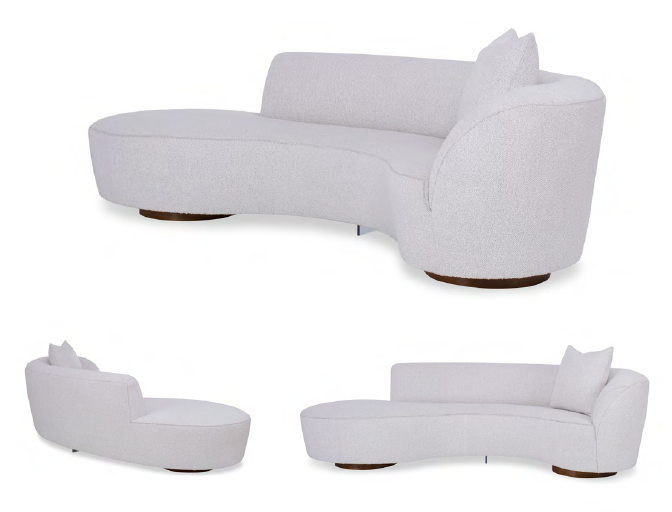
Pictured above is the Claes sofa, a stunning piece with surprisingly broad appeal. Available in a myriad of fabrics, Kravet offers the Claes sofa with a selection of 16 maple and 11 paint finishes for the base. Overall dimensions are 100W x 40D x 30H, with a 22” x 22” matching throw pillow included.

Designed to Make a Statement

Not only are custom options available that can make each piece unique to any space, these organic shapes never fail to make a statement yet comfort remains intrinsic to their design.

kravet franz swivel chair

As companion pieces to the Claes sofa, the Franz (above) and Barnett (below) Swivel Chairs are perfect compliments to the sofa as a central piece.

kravet barnett swivel chair

Both chairs are available in the same fabrics and maple finishes as the sofa and are handcrafted to the same overall dimensions: 35W x 33D x 33H.

Comfort and Style to Please Any Eye

While the pieces on display may be new designs, they continue to display both comfort and style – traditional hallmarks of all Kravet Furniture lines, fabrics, wallcoverings, and more.

kravet clyfford sofa

The Clyfford sofa pictured above is another of the eye-catching seating solutions that are new to the Modern Collection this year. Shown in a Railroaded, non-directional fabric recommended by Kravet, it too makes a statement as the centerpiece of a living room, perhaps with either the Barnett or Franz swivel chairs as compliments. (Or both!)

Finish choices for the Clyfford sofa match the other pieces we’ve shared and the overall dimensions of 118W x 62D x 30H are a touch larger than the Claes.

It goes without saying that the latest additions to this collection are not limited to the pieces we’ve shown you.

kravet modern collection swivel chairs

For example, pictured above are three more swivel chairs, featuring the Judd to the left along with the Franz in different Kravet fabrics.

For information on pricing, availability, or other information about what’s new in the Kravet Modern Collection do not hesitate to… Get in touch with TD Fall today.

Leathercraft Luxury Furnishings – Featured at Fall Market 2021

We were nearly overwhelmed by the response to the lineup of Leathercraft Luxury Furnishings we featured at the recent High Point Fall Market. In fact, Leathercraft was a high point at High Point!

We were also delighted, as well as deeply grateful, by the general response from buyers and designers to all of the products we displayed. While it has always been our mission to support each and every one of you with the best in luxury furnishings for the home and office, your reaction to our lines and efforts to be there for you has been encouraging and gratifying.

We thank you and appreciate all of you more than you can know.

Now, on to the good stuff!

leathercraft luxury furnishings

For more than half a century now, Leathercraft has been designing and manufacturing the finest leather seating available. Headquartered in the highlands of Western North Carolina, an area with the greatest concentration of skilled craftspeople in the country, these talented, highly skilled, and committed artisans are the backbone of Leathercraft’s enduring quality.

Leathercraft at Market

Perhaps the most important reason we chose to represent Leathercraft is their commitment to excellence; not to mention the amazing people who manage the business, design their offerings and build the best leather upholstered furniture in the world.

leathercraft cynthia sofa

Cynthia Sofa 1460 with Juarez Brindle Hair on Hide on the out arm and out Back with a wonderful new full-grain wax and oil pullup. Kodiak Frontier on the balance. The #9 Old Gold nail heads are a standard treatment as well.

And, when we say commitment to excellence, we’re talking about far more than the components of each piece. The craftsmanship that is consistently on display is second to none, and always has been.

leathercraft quality

Leathercraft Home Office Seating Solutions

The fallout and response to pandemic restrictions and work-from-home solutions have led to a renewed and newly intense focus on the home office for many. While Leathercraft has always manufactured a comfortable and compelling lineup of office furniture, interest at Market this year was far greater than in years past.

leathercraft executive chair

In an effort to whet your appetite just a bit, we share this image of the Harvard High Back Swivel Tilt executive chair in Getaway Lagoon with a dark walnut finish from Leathercraft. It was a huge hit at the just-completed Fall Market.

Leathercraft Recliners

Finally, no teaser would be complete without a peek at one of the most beautiful (and popular with buyers at Market) recliners we have ever had the pleasure of offering. (And in which more than one nap was taken that week!)

leathercraft dixie recliner

Unique in its styling, Leathercraft’s Dixie recliner sacrifices nothing in terms of craftsmanship, function, and comfort. Here, the Dixie 1357 Recliner is shown in Rockies A Real Nut leather with Colorado Brown finish on the legs and #9 dark pewter nail heads.

Many Leathercraft Furnishings are Available Now

As declared on the Leathercraft website: “Our goal is to produce upholstered furniture to the highest standards possible utilizing the best materials and employing true-tested manufacturing techniques. In doing so, we want to simplify the ordering process while providing you the opportunity to specify the product that fulfills your requirements.”

So, have we piqued your interest with this brief glimpse of a few of the most popular Leathercraft Luxury Furnishings from Fall High Point Market? For questions about other Leathercraft products, availability, and pricing please, do not hesitate to… Get in touch with TD Fall today.

Manchaha Rugs – New from Jaipur, Introduced at Fall Market

One of the greatest things about attending High Point Market, regardless of the season or circumstances at large, is the introduction of new products. Whether from the competition or in our showroom, seeing new stuff is always exciting. At this year’s fall Market, we have been delighted to introduce a stunning line of handcrafted, artisanal floor coverings, Manchaha rugs from Jaipur.

Manchaha is a Hindi word popular in our weaving community. It means “Expression of my heart”. The line is a sustainable development initiative where weavers get to design their own rugs for the first time ever. It taps into the untamed fashion in rural India by nurturing their creative potential and transforms a community from exploitation to empowerment.

Unparalleled Craftsmanship and Creativity

With designs that are truly from the heart for these uncommonly talented yet previously ignored rural weavers, the intricacy of design and attention to detail on display left many who saw the line of Manchaha rugs for the first time speechless. Made with leftover batches of yarn, each rug is one of a kind. Handcrafted with impeccable attention to detail and made from the weaver’s design, each rug tells a unique story.

Handcrafted Artisanal Rugs from Jaipur

The Manchaha Rugs Collection from Jaipur is evocative, prompting a different emotional response in everyone who sees these marvelous rugs. Like works of art, each piece is handmade using leftover, handspun yarn batches. Besides being an impressive example of sustainable production, this results in rugs as unique in design as they are in color.

While the phrase “Expression of my heart” could not be more appropriate for us at TD Fall, the meaning of the word is far more dramatic... Stunning and Unique.

The intricacy of design, stunning craftsmanship, and availability are hallmarks of this new line of rugs from Jaipur.

Needless to say, while it can be exhausting, we love going to High Point, and this year’s Fall Market, with so many new home furnishing lines, was no exception.

Looking for more new home furnishing collections, news about High Point Fall Market, the latest interior design trends, marketing tips, and ideas? Get in touch with TD Fall today.

Interior Design Sales – Getting Your Share of Projected Design Industry Growth

According to the independent wire service GlobalNewswire.com, the good news about interior design sales is: “The Global Interior Design Services Market is expected to grow by $ 24.13 bn during 2021-2025 progressing at a CAGR [compound annual growth rate] of about 4% during the forecast period.”

And remember, while a 4% growth rate may not seem like much at first glance when you take into consideration the industry-wide shortages and worldwide shipping problems, any growth in our industry is something to celebrate.

The bad news is, if you're an independent designer, getting your share of that growth in sales is 100% up to you! (OK, that’s not necessarily bad news – unless you’d rather get a couple of teeth pulled than have to sell your design services!)

It may shock some folks to discover this but, very few interior designers got into the business, or started their own design firm, because they love selling stuff. No, designers are creative souls and their priority is sharing that creativity with prospects and clients. But, as we’ve shared many times over the past few years, when you own a design business, selling is part of the job. And selling yourself must be your priority!

interior design sales.jpg

So, what are the keys to getting past the wish that you didn’t have to sell anything, ever?

3 Tips to Overcome Your Aversion to Selling

We’ve been doing this for a while now, if you call more than a quarter-century a while, and there are a few things we’ve learned that can help.

  1. Mindset is key – The power of thinking positively is a massive asset when selling anything; from kibble to cars to, well, interior design services. Clients and prospects can sense when you're uncomfortable and they will inevitably wonder why. Since they don’t know you’re struggling with the sales process, they’ll assume something else is wrong and will try to fill in the blanks for themselves. Is she telling us the truth about that furniture? Is the quality of the rugs she’s recommending poor, so not worth the investment? Is she just not very good at reimagining our space for us?

Once a client or prospect begins to doubt you – for whatever reason – you’ve lost them. And, you have a less than 1% chance of getting them back! So, be positive and force yourself to learn the steps required to sell your services and furnishings more effectively.

2. Be upfront about potential problems – As mentioned above, our industry is currently coping with a number of challenges with product availability. The reasons vary by manufacturer, often based on their size and influence, so it behooves the sharp designer to be open about the issues you may encounter on their behalf. Stress that many wallcoverings, fabrics, and accent pieces are available immediately (or almost so) and that you can deliver their beautiful new furnishings in stages, if they prefer. (BTW… That’s a great way to show optimism during your presentation!)

Not to toot our own horn here but, because we represent the largest manufacturer in the world, industry-leading Kravet and their family of brands, we suggest you consider their offerings first. Much of what they offer will have shorter lead times than other brands, making your job far easier.

3. Know your stuff – Knowledge truly is powerful and the more you know about your chosen profession the more confident and optimistic you’ll appear to clients and prospects. You literally can’t “know too much”. (You can, however, share too much so keep yourself in check and don’t go overboard or “show off” your expertise.)

One of the most common reasons novice salespeople struggle is a lack of knowledge. They simply don’t know enough to answer all of their prospect's questions and, fearing they’ll look unprofessional by admitting it, they fake it. But, again, insincerity is a dead giveaway to clients and is truly unprofessional. Never be afraid to admit you don’t have an answer for them at the moment. Just tell them you're unsure and you'll get them an answer as quickly as humanly possible. If you’ve been upfront and honest to that point, it won't be an issue.

Finally, preparation is critical to a successful sales pitch. Never try to “wing it”. Don’t ever think you can “fake it to make it”. Instead, bring all you have to every sales encounter, your talents, your knowledge, your creativity, and your commitment to giving them the best interior design experience you can provide.

With a bit of training and experience, along with a commitment to yourself to get better, your ability to sell your services and the furnishings to make your vision a reality in your client’s homes will be realized – with less lost sleep the night before a presentation!

If you struggle with interior design sales for your own business, consider working with a consultant and/or sales trainer. Ted is available for such business consulting to the trade. Just… Get in touch with TD Fall today.
The 80/20 Rule of Business – Have You Heard of It?

Have you heard of the 80/20 Rule? It’s kinda cool, and can be kinda sad. Named for the original proponent of the concept, Vilfredo Pareto (1848-1923), the Pareto Principle outlines the concept of disproportion. Or, to put it more simply, life’s not fair!

And, while the exact percentages may shift here and there based on circumstance, it has value when applied to things such as effort vs outcomes, allocation of resources, and even revenue flow.

“More generally, the Pareto Principle is the observation that most things in life are not distributed evenly. It can mean all of the following things:

  • 20% of the input creates 80% of the result

  • 20% of the workers produce 80% of the result

  • 20% of the customers create 80% of the revenue

  • 20% of the bugs cause 80% of the crashes

  • 20% of the features cause 80% of the usage

Also, recognize that the numbers don’t have to be ‘20%’ and ‘80%’ exactly. The key point is that most things in life (effort, reward, output) are not distributed evenly – some contribute more than others.” (BetterExplained.com)

Pareto Principle in Business & Selling

When it comes to sales in general, and this is very general, approximately 80% of sales will come from 20% of the products or services being offered. Does this mean you can shave all those furnishing catalogs down to one-fifth of what the manufacturers offer and present your clients with a streamlined version of the things you might present to them? No!

As an example, we know a former sporting goods salesman who represented a wholesale operation with multiple manufacturers and some ten thousand products available. Ten Thousand! Did he offer every one of those products to every customer? Of course not. He focused his efforts on the best sellers – but – he also knew that without the other 8,000 or so items in his catalog and warehouse, the peripheral, seldom-sold items, he would not be considered a full-service dealer.

In other words, there is just some stuff you need to have available to be considered legitimate and professional – even if you don’t sell much of it often.

For an interior designer, that might mean working with a local, artisan furniture company as well as a full-service, industry-leading furnishing manufacturer like Kravet.

80/20 Rule Not Written in Stone!

While the 80/20 Rule is a great guide for a small business owner with a few employees or sub-contractors they work with, it’s important to remember that this is not an inflexible law of nature like, say, gravity. The Pareto Principle is an observation of human nature more than anything else and should be understood as such.

Having said that, it’s also important to keep in mind that:

“The Pareto Principle helps you realize that the majority of results come from a minority of inputs. Knowing this, if…

  • 20% of workers contribute 80% of results: Focus on rewarding these employees.

  • 20% of bugs contribute 80% of crashes: Focus on fixing these bugs first.

  • 20% of customers contribute 80% of revenue: Focus on satisfying these customers.

The examples go on. The point is to realize that you can often focus your effort on the 20% that makes a difference, instead of the 80% that doesn’t add much.” But never forget it’s available to you.

So, stick to the one-fifth (or so) of the stuff that matters and the rest will usually take care of itself.

In the meantime, if you think you could use some help figuring out where your most important 20% is, and where that 80% benefit will come from, Ted is available for business consulting to interior designers and furnishing dealers, virtually and face-to-face locally. Just… Get in touch with TD Fall today.
Client Qualifying – The Pitfalls and Impact of Infinite Online Information

As designers and furnishing suppliers, it’s important to know what clients and prospects have in mind for the spaces in which they live. This can be done through the time-honored selling process known as client qualifying; essentially, asking insightful questions and actively listening to their answers.

Beyond this though, and perhaps more importantly, discovering what they’re being told about the interior design process is just as critical. Consider for a moment the seemingly infinite amount of information from countless sources available with a just few strokes or swipes of a keyboard or screen. After performing their “due diligence” with online “research”, your prospects can come to you with just enough knowledge to make them dangerous – to themselves and you.

We discussed a potential example of this in a previous post on the ethics of Designer Product Markups and whether increased transparency in the industry will end the practice and force interior designers to charge only for their time.

client qualifying.jpg

Qualifying a Knowledgeable Prospect

While far too many designers loathe the sales process, and yes, that includes client qualifying, unless one is willing to hire a sales professional or team to handle it, it simply can’t be avoided. This is where knowing what they know, and where they learned it, can help you close the sale on design projects and/or luxury furnishing sales.

First, getting to know the best sources of “inside knowledge” that are available to potential consumers can be beneficial. There are just so many online consumer-oriented sites like Houzz.com, HGTV.com, and HouseBeautiful.com it can be hard to grasp where they get their information. Then too, they can just as easily access that are more targeted to the industry, like BusinessOfHome.com or “insider” info sites like BuzzFeed.com.

So, how does the sharp designer or furnishings dealer overcome this potentially disruptive trend of consumers who want to be “in the know” about how designers work and by their products?

By doing their own research and being ready to answer the qualifying questions prospects will have for them!

Impress and Protect Your Own Interests

Here, the quote that is commonly attributed to Sir Francis Bacon, “Knowledge is power”, rings especially true because your greater grasp of the industry and luxury furnishings will not only impress, it will also protect – you and your ability to work with them.

For example, these three consumer-oriented tips from Houzz.com recently caught our eye. And, while they may seem elementary to design and furnishing professionals, they may seem true insider tips to consumers. Possessing and sharing such “insider” knowledge with your prospects could go a long way toward locking down your next design project deal.

  1. Specify a Purpose for Your Spaces – Understand what you’re looking to establish with your space and its functionality. “Your professional team is there to offer solutions you might not have thought of, so take advantage of that,” advises Ft. Collins, CO designer Amy Laner. “Keep an open mind and be open to their suggestions – you want to do your due diligence so you don’t regret anything.”

  2. Determine Costs Before You Begin – Establishing a price range is imperative, so contact a few local contractors to understand exactly what things will cost. “Get a cost estimate or two; they should include pricing on permitting,” Laner says. “The more information you begin with, the easier it will be to make informed decisions on how to create the space you want.”

  3. Personalize Your Home – Your home should reflect your personality, so use furniture, decor, or details that have meaning to you and your family. “Add what will make you happy in your own space,” Laner says.

Again, these tips will seem elementary to a well-trained, knowledgeable, and experienced professional interior designer. Yet, to the uninitiated homeowner who’s considering a remodel, these concepts may appear unique and invaluable. Knowing things like this in advance could be the difference between merely submitting a quote and contract and landing the job.

It’s important to keep in mind just how personal our industry can be. With that in mind, it’s impossible to “know too much”; too much about other designer’s services in your area, too much about furnishings that are currently available, too much about what your prospects may know and need (which can be very different things!).

Want to know more? Ted remains available for business and sales consulting to interior designers and luxury furnishing dealers, whether local or virtually in distant markets. With more than 25 years of experience in the industry, he’s pretty much seen it all, from the basics of client qualifying to overcoming the challenges of scarcity and lead time issues we’re currently experiencing. Feel free to… Get in touch with TD Fall today.