Designer Product Markups vs Handling Fees – Business Ethics vs Business Reality

The ethical question of designer product markups is as old as the industry, as are their use (and client complaints about them!). And yet, the idea that increased transparency in the industry will end the practice and force interior designers to charge only for their time persists.

Of course, the reality is that virtually all segments “of the global economy run on markups, and we take most of them for granted”, argues BusinessOfHome.com author Fred Nicolaus. “No one walks into a grocery store and indignantly asks the manager what the wholesale price for a gallon of milk is. In fact, some version of that analogy is often used by designers to shut down clients who poke and prod at the idea of markups.” (emphasis added)

He continues, “The challenges of the model have always existed. But let’s not kid ourselves: Markups work. The model has stood the test of time, undergoing very little change over the past 50 years of the design industry. The vast majority of designers have relied on some kind of markup to keep the lights on. While the amount of that markup might have changed a bit, the basic idea hasn’t shifted.”

designer product markups.png

Is Online Shopping the Problem?

Although the arguments above ring true, they beg the question of how the ubiquitous use of the internet and increasingly intelligent search algorithms have impacted design client's ability to price the products their designer may recommend.

“Over the past few years,” Nicolaus claims, “designers across the country have begun to notice something: Their clients have gotten really good at shopping online. As more commerce becomes e-commerce, a trend rapidly accelerated by the pandemic, there’s simply so much stuff available online, and so many tools to find the lowest possible price among hundreds.

“In the past, if a client wanted to “shop” their designer, they’d have to visit outlet malls, sneak into a design center, or at least make some phone calls. Now it’s often as simple as a reverse Google image search. That reality has only been compounded by the fact that many once trade-only brands are now available online in some form for consumers to browse. The result is a constant second-guessing on the price of, well, everything.”

Beyond simple price shopping, however, the internet has made it possible for prospects and clients to “glean the mechanics of the industry”. That is, to understand the generally accepted practices designers use to price their services, including product markups that may seem less than ethical to them.

How Do Most Designers Cope?

As the article explains, opinions on the question of designer product markups run a predictable gamut, ranging from zero product markups to whatever the market will bear. But, ultimately, the question of ethics versus the reality of necessity can only be addressed by the individual designer and must be based on the relationships they have with their clients.

As one former mattress supplier related to us:

“Many years ago I sold luxury mattresses to a local interior designer in Denver. Though it reduced my commission, I wanted her business so I gave her a pretty hefty discount from the retail price. I know she then added something to the price for her clients. I have no idea what her markup was but I believed then and still do today, that designer product markups should simply match the discount they receive. Unless there are a bunch of custom upgrades, of course.”

Then again, Ted takes a different view:

“I’ve always been in favor of product markups for interior designers. The thing the BOH article fails to mention is that the markup is not so much a profit center as it is to cover the administrative costs associated with purchasing, follow-up, receiving, and installation of the products ordered.

“From what I’ve heard and seen, designer markups tend to range from 15% to 60%, depending on the scope of the project. When you go to a retail store, all those costs are rolled into the retail price and hidden from you. Designer product markups are much more transparent.”

What are your thoughts on the subject of designer product markups? What has worked best for you? Feel free to share your comments with us. And, if you're undecided and would like to get some help outlining a product markup policy for your design business, Ted remains available for business consulting to the industry. Get in touch with TD Fall today.

Hot Home Design Trends – Tips for Interior Designers and Furnishing Dealers

What’s hot in home design trends this year? Home office designs. Flexible, dedicated spaces. Going green – the color, not the practice. And… Pillows! Wait, wut?

Yes, according to the folks at Houzz.com, the latest trends in home design and renovations show spikes in interest for everything from home theaters to reimagined kitchens and bathrooms, and from home gyms to accent pillows. Again with the pillows? WLP? (We Love Pillows)!

In an article from August, author Mitchell Parker explained how the online design and renovation site performed an analysis of searches among their audience between 2020 and 2021. Their goal was “to see how home design interests are changing” over the past year. And, while searches may not always translate to actions by consumers, we can certainly perceive trends for which we should be prepared.

(Oh, and, we’ll get to the pillow thing soon. We promise.)

Dedicate Yourself to Creating Dedicated Activity Spaces

Perhaps most interesting for interior designers and furniture dealers, interest in dedicated activity spaces showed a marked increase over the 12 months examined.

Thanks in large part to the pandemic, or the steps imposed by outside forces to “curb” it, the home has increasingly become the 24/7 center of activity for many families. As Parker explains, “The local gym, bar, theater, and office turned hyper-local as people made room to accommodate these activities at home. It’s a major shift in how people think about their homes and one that probably isn’t going away anytime soon.”

Clearly, the Houzz search data on dedicated activity spaces speak for itself:

home design trends.png

While the trend toward home offices is to be expected, there is far more going on in American homes than we might have anticipated. Seeing these numbers, the sharp interior designer will be ready for prospective clients who are part of these trends – or wish to be.

Green is The Color of The Moment

“Green is having a moment – and not just in one area of the home, but in several. Searches for green kitchen cabinets were up 829%.”

From decadent to delicious, the color green is as versatile as your imagination can, well, imagine it being. Long neglected in home décor and design, the color can provide a sense of warmth and comfort unequaled by other, more popular, hues.

“I think green is trending for a few reasons,” color consultant Jennifer Ott says. “First off, after years of whites, grays, and cool blues being popular, it seems folks are moving more toward warmer hues. Green bridges warm and cool, so it’s a good transition between the two. It works well with white and gray but also tans and creams.”

design search trends.jpg

Not to be outdone, Kravet’s Lee Jofa line features the color as integral to their new Mindoro Collection.

Decorating for Comfort and Style at Multiple Levels

No longer exclusive to elites, home decorating has reached all levels of income and style.

“Renovations to kitchens and bathrooms command a lot of the home design conversation. But decorating seems to be experiencing a particular boom in interest. Searches for home accents increased a whopping 2,417%, while searches for decorative accents rose 799%.”

Still not convinced? “Searches increased significantly for velvet sofas (121%), gold wall mirrors (606%), and gold table lamps (1,166%). The search for champagne, likely in connection with champagne bronze finishes, increased 846%.”

interior design trends.png

Oh, hey… Did we happen to mention pillows? Why did we? Well… “Interest in accent pillows is taking off too. Searches on Houzz skyrocketed 5,050%.” That’s why!

Here are links to our in stock pillows from:

“Jennifer Wundrow Interior Design used a stylish mix of color and pattern in the accent pillows shown [above] to tie together various tones and patterns for a cohesive design.”

There’s plenty more to unpack from the article but, us being who we are, we have our own home design trends to share. Just click here to find out more and… Get in touch with TD Fall today.

Inbound Marketing vs Content Marketing (What’s the diff, if any?)

Online marketing. Internet marketing. Social media marketing. Video marketing. Email marketing. Inbound marketing. Content marketing. “Do this one or your business will die!” “Do that one and your business will grow!” “Do the other thing and your business is guaranteed to grow/die/get better/fail/be profitable/never make money!”

But wait. With the internet being universal, aren’t all those things kinda the same these days? Not so much.

You see, some of these things are broad marketing strategies while others are more specific types of marketing techniques. For example, the two in our title this week: inbound marketing versus content marketing.

As part of your broad-based online marketing strategy, content marketing is aimed at your target audience in general. Inbound marketing is directed at a clearly identified type of potential client; a “buyer persona” that you create as the perfect client for your services (or products).

inbound marketing strategy

Content Marketing Strategy

As defined by Wikipedia, “Content marketing is a form of marketing focused on creating, publishing, and distributing content for a targeted audience online.” As you can see, there is nothing about a “persona” or “profile” in this definition of content marketing. Here, your target audience is pretty much anyone who might be interested in your services. This requires you to generate content that has a broad appeal to a diverse audience.

This may be very easy, or very hard. That is, it can be difficult to avoid stating the obvious or sharing platitudes when you write for such an audience because it’s often difficult to focus on exactly who may be interested in your content. It can also be seen as intrusive (and possibly unwanted). On the other hand, when you get it right, the appeal of such content can be far-reaching and may generate interest among folks you had no idea might wish to do business with you.

Such an audience might be defined as:

  • Homeowners

  • Local

  • Single or married with kids

  • Mid- to upper-mid income range

  • Likely works for others

  • Active on social media

  • Pain points are a bit vague and generalized

  • May be interested in DIY training

As you can see, these are essentially categories of people who may someday wish to work with an interior designer or buy from a luxury furniture store. Such timeframes and wishes are by definition vague, as are the categories. However, it is possible to generate interest with content marketing, which can then be used to engage your audience in a more targeted fashion: for example, email campaigns or newsletter subscriptions.

Inbound Marketing Strategy

Requiring in-depth research and marketing know-how, “Inbound marketing is a business methodology that attracts customers by creating valuable content and experiences tailored to them. While outbound marketing interrupts your audience with content they don’t always want, inbound marketing forms connections they are looking for and solves problems they already have.” (Hubspot.com)

Further, inbound marketing focuses on building a website, its content, and a clearly defined audience. The strategy here is targeted to encourage readers to “perform an action such as inquire, buy a product, or complete a form”. (Spyralitics.com)

Inbound marketing content is interactive. It’s targeted, purposeful, and helpful. It is not intrusive (and therefore not unwanted), because you're providing your audience with content they’re searching for – and need.

Your targeted “buyer persona” or “ideal client profile” for an inbound marketing strategy might include:

  • Owns a home worth $1 million or more

  • Lives in a specific, high-end local neighborhood(s)

  • Is a married female with a family

  • Enjoys an upper-income range for your area

  • May work in a creative profession

  • Likely small business owner, entrepreneur, or other professional

  • Is active on specific social media platforms

  • Has well-defined needs and desires, with distinctive (perhaps unique) pain points

  • Appreciates expert knowledge and professional services from a creative influencer

As you can see, the profile of your potential audience here is far more specific and targeted. It can be narrowed even further with additional research and based upon experiences with previous clients. That is, clients you’ve most enjoyed working with in the past.

Stated simply, inbound marketing does not rely upon a silhouette of what is possible in your audience, but a portrait of who you want your audience to be.

While we do not happen to offer inbound marketing or content marketing support at TD Fall, we do have contacts who can. And, of course, Ted is available for general marketing and business consulting to the industry. Get in touch with TD Fall today.

Home Furnishing Lead Times – Strategies for Coping with Delays

From rugs to wallcoverings and from fabrics to furniture – especially upholstered furniture – home furnishing lead times are some of the worst we’ve seen in decades. Designers and furnishing dealers are reporting delays from mere weeks to months to, well, to “We have no idea” lead times. Coping with this upheaval has become a fundamental challenge that can make the difference in everything from keeping clients happy to staying in business.

home furnishing lead times.png

While interest in design projects has grown nicely in the past 12-24 months, the worldwide foam shortage and shipping delays have made following through on renovation projects difficult for designers and furnishing retailers.

An interesting piece at the Business of Home blog brought this even more clearly to mind recently, as a dozen designers were asked about their strategies for dealing with delays.

Is it Possible to Keep Home Furnishing Clients Happy?

The first and most important thing to remember in times of stress is that our industry is built on relationships. Whether designer to client or designer to supplier, working with people you know and trust will always be the key to getting through tough times. The same is true for you, of course. As a designer, you too must be honest, open, and trustworthy. Otherwise, when things improve, you’ll find yourself on the outside looking in.

You must… Be open with clients. Never hide extended lead times or other availability issues. Always communicate in both directions: with clients and suppliers. Always share the results of your communication as needed – not just when it might benefit you in some way. (Getting the bad news out of the way up front will nearly always benefit you in the long run.)

According to the article, some designers have benefited from using local artisans to help fill the gaps created by delays from larger manufacturers. Says Lisa Kahn of Lisa Kahn Designs in Naples, Florida, “We are also keeping the money in our local economy and community, which feels amazing!”

Naturally, limited sources will affect a designer's creativity, “Because lead times are now part of the list of things we have to consider when making decor and furniture selections”, explained Kelly R. Collier-Clark of Plot Twist Design in Philadelphia.

The answer then may be to broaden your thinking to include solutions you may not have been inclined to consider in the past. Since some of the most expensive furnishings have been the hardest hit, perhaps it’s time to lower your client’s expectations just a bit and let them know that very good to excellent are reasonable alternatives to what some consider “only the best”.

It’s Time to Choose

Sharp designers always offer their clients choices – though it’s best not to offer too many or they may never make up their minds. In the current marketplace, however, their choices, and yours, are stark and limited.

For many, perception is reality and for too many in the industry the current list of choices includes:

  • Available immediately (if you order right now)

  • Estimated 3 months (maybe)

  • Estimated 6 months (maybe)

  • Open-ended – it gets here when it gets here (if at all)

When choices are not really choices, what’s a designer to do?

  • Continue to wait (and wait, and wait)

  • Search endlessly for in-stock items (and hope the inventory is accurate)

  • Substitute lesser items temporarily

  • Deliver available pieces, uhm, piecemeal

  • Find local artisans who might fill in temporarily

    • OR

  • Use Kravet QuickShip

  • Use Curated Kravet

  • Call TD Fall & Co

When you’ve been invited to help someone make improvements to their home, you're working with them on an intimate level unlike many others they may employ. They want their spaces more livable, as well as beautiful. Accomplishing this has always been about the relationship you build with them, yes, but – now more than ever – you must also manage expectations.

As explained by Rachel Humphreys and Katie Orr of Humphrey Orr Interiors in Summit, New Jersey “While our clients are often disappointed with these longer-than-normal lead times, we’ve found that communication is essential. Being upfront and honest with the installation schedule and potential delays has been our key to managing client expectations.”

We Can Deliver

Currently, Kravet is only running a few weeks behind its normal production. Kravet Quick Ship is now approximately 8 weeks and regular lead times are currently running 12-17 weeks, depending upon the frame.

Though these lead times relate mostly to upholstered furniture, for the time being, there has been some disruption and delays in all product categories.

The good news is… Most fabric and wallcovering orders are flowing fine, especially on domestically produced goods. In-stock rugs are also shipping quickly with any delays due solely to logistics issues. Imported products remain an issue, whether it's due to pandemic-related shutdowns, the ongoing foam shortage, or other shipping delays. (Anyone have a shipping container they’re not using at the moment?!?)

There are some caveats and disruptions but the customer is always kept informed! And, since we have the latest info on availability and home furnishing lead times, feel free to… Call us today for the latest on lead times from the Kravet Family of Brands.

Interior Designers Job Description – 7 Hated Aspects of Entrepreneurship

If we take a look at the contemporary interior designers' job description, we find something interesting. And, when we say, “job description”, we’re talking about a real-world, marketplace-driven depiction.

interior designers job description.jpg

Few will doubt that the most powerful reason for becoming an independent designer is freedom: not only creative freedom but, hopefully, financial freedom, as well. And yet… While you (FINALLY) get to be The Boss, there are aspects of entrepreneurship that are truly mind-numbing and energy-draining, things that can make the cost of that freedom seem incredibly expensive.

This was brought to mind by an article we found titled, 20 Entrepreneurs Reveal What They Hate About Being an Entrepreneur. While it doesn’t offer many solutions, those suggestions come from us, the list can't help but make one take some time to think things through a bit more deeply. We’ve chosen our Top 7 from the list but, don’t hesitate to check it out yourself. (It’s a doozy!)

7 Costs of Business Independence

  • Risk – The financial risk involved with a business startup is perhaps the most common reason an interior designer might not take the leap into working for herself (or himself). Getting started is an incredible challenge of course, but dealing with the unstable nature of business in general – and interior design in particular – can definitely keep you up at night. Ultimately, you need faith to make it happen, in yourself and your business purpose.

  • Responsibility – When things go right, there’s no better feeling AND you get all the praise! But, when things go wrong – you're on the hook for it – forever and for always! After all, you're now The Boss (see above), and that means you will be held to account for ANY problems that develop in a remodeling or design project. Acceptance is key here. You asked for it, you got it. Accept responsibility and keep moving forward.

  • Micromanaging – Taking care of mundane business tasks, the “paperwork” of old, is a total drag, whether actual paper or digital records. From creating invoices to writing checks for everything, and so much more, every detail must be managed and the buck can only stop with you! In the beginning, this should be something you can live with. Eventually, though, you'll need to learn to delegate tasks and, for a micro-manager, that ain’t easy!

  • Timesuck – Oy, the hours you’ll put in! Time management (or the lack thereof) is perhaps the most common complaint among even the most successful entrepreneurs. There simply are not enough hours in the day so, working past midnight and on weekends becomes commonplace. And, you can pretty much forget about taking a vacation for the first few years – at least. (See below)

  • Team building – Once your design business is on a roll, further growth will require team-building skills not taught in most design schools. Heck, it’s not taught in most business schools. (Not real-world skills, anyway!) Often, by the time you accept that you need help, you're well past the point where you should have sought it. This can make your search feel desperate, to the point you’re willing to accept almost anyone with a pulse. Instead, get started early and give yourself time to grow into accepting help even as your business continues to grow. (And maybe even take a vacation.)

  • Delegation – Similar to team building, delegating tasks to others is nearly always a challenge to a far-seeing entrepreneur. Will they share your vision? Can they further your mission? And, once you get used to doing everything yourself, which is inevitable with a startup, issues of competency and trust rear their heads. Hey, you gotta start sometime and, if your family no longer recognizes you when you occasionally make it home in time for dinner, well…

  • It’s lonely at the top – Well, not really, since everyone and their brother are making demands of you! But, you get the drift here. All of that responsibility and risk, that managing of projects and people, the energy-sapping time demands, and the need to rely on others are decidedly NOT the reasons you started your interior design business.

Unfortunately, these are just some of the costs of satisfying your entrepreneurial spirit and going out on your own. Are they worth it? You betcha’! (Just ask Ted.)

While there are no easy answers, and all platitudes suck, you can find some peace and reduce stress through mindfulness, acceptance, and gratitude. Stay conscious of your purpose, not just your business vision or mission. Accept that, for a while at least, these costs can only be borne by you but that, in the long run, things will get better. And finally, be grateful that you are able your pursue your dreams and are on the way to making them real. (That’s a Big Deal, right there!)

Need help? As always, Ted remains available to help you get there with business consulting to the trade, locally or virtually. (Or, virtually local. Whatever!) So, feel free to … Get in touch with TD Fall today.

Strong Upward Movement in Decorating & Home Renovations for 2020 and 2021

We’ve been seeing some interesting trends in home renovations nationwide for the past couple of years. And, while interior design is a local phenomenon (as we never fail to mention whenever possible), the latest national metrics are encouraging for all of us in the industry.

It’s understandable if you resented the lockdowns and stay-at-home orders imposed on most of the country last year. However, they seem to have had a positive effect on the decorating and home renovation areas of the marketplace. In fact, according to the most recent Home Renovation Trends Study by Houzz.com, these areas are experiencing some nice growth.

  • Home Renovation Spend Rises: Home renovation spending has grown 15% in the last year to a median of $15,000. Higher-budget projects (with the top 10% of project spend) saw an increase from $85,000 or more in 2020, compared with $80,000 in the two years prior.”

We found it especially interesting that, “The gap between median renovation spend by Baby Boomers and Gen Xers narrowed in 2020. Baby Boomers ($15,000) spent the most on their renovations and Gen Xers ($14,000) are no longer a distant second. The top 10% of renovation projects among these generations were at least $90,000 and $85,000, respectively.”

home renovations up

Where Home Renovation Dollars are Being Spent

Kitchens and bathrooms remain the most popular spaces for renovation among all age groups. Yet, it should come as no surprise that the younger generations placed a heavier emphasis on home office renovation than did the older. This is surely a result of the work-from-home trend that we saw as a result of the pandemic and Millennials and Gen Xers acted on this.

home decorating projects up

According to the study, “Millennials (17%) and Gen Xers (16%) renovated their home offices more actively than older generations. At least 1 in 5 homeowners across all generations renovated their master bathrooms in 2020.” We see no reason this should change in 2021 and even in 2022.

Further, “Automation and security upgrades are top priorities for Millennials, compared with older generations. Exterior paint upgrades were more common than deck upgrades among homeowners, and especially among Baby Boomers (21%).”

Kitchen Renovations Remain a Priority

While all of these metrics are well and good, we continue to maintain that the kitchen is the most popular – and therefore the most important – room in nearly every home. And, when it comes to home renovation projects, the data prove this to be true; especially for large kitchens (i.e., more than 200 square feet).

  • Homeowners Invest In Large Kitchens: Kitchen projects are the most popular among renovating homeowners, and while median spending has been flat on these projects for the past three years, investment on major remodels of large kitchens jumped 14% to $40,000 in 2020 compared with $35,000 in 2019.”

“Spend on kitchen remodels remained stable at $12,000 in 2020. That said, homeowners with kitchens larger than 200 square feet spent 14% more on major kitchen remodels, where all of the cabinets and appliances were replaced.” (emphasis added)

kitchen renovations priority

While bathrooms remain the second most popular spend for home renovations, the dollars spent tend to be far less than for a kitchen remodel of virtually any size.

design projects increase

Finally, two of the more delicious and delightful metrics revealed by the study include: cash remains the leading form of payment for home renovations at 83%. And, the demand for interior designers, construction professionals, and other home renovation specialists is up across the board. So, while DIY remains popular, renovation and design professionals have much to look forward to across all age groups.

While optimistic, these metrics are of necessity based on data collected nationally. If you have yet to see such upward trends in your local market, Ted may be able to help. He is available for business coaching and consulting to designers and furnishing dealers. With more than 25 years of experience in the luxury furnishings and interior design industries, he can help with branding, client acquisition, and general marketing solutions to help you grow your business. Feel free to… Get in touch with TD Fall today.

High-Value Website Content not Attracting an Audience? Repurpose It!

Do you have a long piece of high-value content on your website that visitors are ignoring? Is it something you spent hours (or days) creating to make your furnishing client’s and design prospect’s lives easier? Why the heck won't they read or view it?

Well, the first thing to know is that everyone’s attention span seems to be shrinking. For example, in 2015 the average time spent on a website page was about 58 seconds. Today, that metric has shrunk to a scary 36 seconds or so.

While these time-on-site numbers look ridiculously brief, take a moment to reflect on your own online behavior. What happens when you search for “interior design trends 2021”? For us, Bing returned some 4.5 BILLION results! Then we had to choose between sites offering “38 trends”, “10 hot trends”, “the 25 hot looks for 2021”, “videos of trends”, a “what the experts think” piece, and, and, and… ad infinitum.

Clicking on a couple of them, the first thing we noticed was that we had no idea who was telling us what the hot trends were. In fact, some of the articles didn’t even identify the author! There went 36 seconds of our lives wasted.

Next, we struggled to uncover where these trends were so trendy. This is disconcerting because – as we’ve said so many times – interior design is local and things that are super trendy in one area of the country may be behind the curve or thought of as just plain yucky where you come from.

Needless to say, we didn’t spend much time on any of them. Instead, we rely on our own experiences and guidance from our suppliers and clients. Why? Because they know what’s going on in their markets better than some anonymous blogger ever will!

website content tips

Repurpose Content for Short Attention Spans

With all of this in mind, the question remains, how do you keep visitors on-site when they have the attention span of a four-year-old?

Well, here’s the thing. That wonderful piece of content we mentioned in the opening of this post may simply be too long for your audience to read. After all, no one can absorb a 5000-word article in one to half a minute. Heck, most of your visitors will see how long it is and run for the hills (virtually speaking).

The solution? Cut, cut, cut it down and turn it into a series of posts. Then, as you reconstruct your genius-level content, use eye-catching headings for sections, and add bullet points, bold text, and underlining. These techniques are used by professional copywriters to stop the reader from scanning content, and actually take it in.

You see, the idea is to sort of “play to your audience” and give them what they need in smaller doses using tricks that slow them down so they take the time to absorb your content.

·         Or watch all of a video.

·         Or listen to a podcast.

·         You get the drift.

·         (See what we did there? And here?)

Again, the goal here is to refine your delivery in ways that your audience is comfortable absorbing. You can't take it personally that they don’t appreciate the effort you’ve already put into creating something that should be valuable to them. Instead, it’s your job to find a format for presenting content that makes it easier to digest and which will ensure they recognize the value.

Getting Your Content Right Isn’t Always Easy

Creating valuable website content that draws traffic, encourages engagement, and produces leads may be the most challenging aspect of online marketing. We work hard on it every week and, while we hope our audience – you – finds the information we share valuable, we also know we can't please all of the people all of the time.

That’s why we bounce back and forth between subjects. We jump from business building tips to design trends or from new products or new lines we carry to news about production and shipping delays. Our thinking in doing this is that different people look for different things from us and if we stay on a single subject week after week, we may lose you. (Or, at a minimum, bore you.)

We recommend you do the same on your business website. Share your thoughts and experiences in ways that will appeal to your audience, not in ways that appeal to you. Keep focused on their needs rather than your own and do everything you can to make sure the content you offer addresses a need or solution your audience is looking for.

Well, that’s about it. We’ve passed the 750-word threshold and we know from experience that’s about the limit for our audience. So, if you have questions or comments about creating or repurposing your best website content, let us know. All you have to do is… Get in touch with TD Fall today.

Living Room Design – Seating Arrangements and Style from Leathercraft

What is the purpose of a living room? Is it a showplace or a true living space? The answers to these questions will vary from one design client to another (and another, and another, and…), but the one thing they will have in common is – seating arrangements. That is, whether showplace or living space, comfort and style will be needed in any living room design.

One of our most popular lines at this year’s Spring High Point Market was Leathercraft furniture. Of course, the line always presents well but this year we experienced an even more positive response to the product line than in recent markets.

“Why is that?” you ask. Well, because Leathercraft furniture embodies comfort and style, of course!

Robinson Sofa from Leathercraft (with Asha accent chair)

As the centerpiece of any living room, the sofa sets the stage while other pieces complement it. The Robinson sofa from Leathercraft grabs the eye while inviting one to take a seat and stay for a while. With myriad wood and leather finishes available (literally hundreds of leathers), using the Robinson to set the stage for surrounding pieces will make any designer’s life easier.

robinson1.jpeg

And don’t forget the handcrafted detailing, powder coat finishing of framing and internal mechanisms, along with more than 40 nail head choices to fit any look – and ensure the Robinson is unique for your clients.

Asha Accent Chair from Leathercraft

Of course, not every guest who visits your client’s home will fit on a single sofa (and some may not wish to). The Asha chair shown in an attention-grabbing finish alongside the Robinson sofa above offers a wonderful opportunity for you to add stylish comfort to your living room design.

Part of the Project Hope Foundation Collection for autism research, the Asha chair is a socially conscious yet stunning accent to any living room, with comfort as a given. With nearly 30 wood finishes and dozens of leather finish choices, you’ll have no worries about color, texture, or quality when you choose these pieces as accents for your client’s living spaces.

asha1.jpeg

Phantom Recliner from Leathercraft

Then again, for a space that will be used for living rather than showing, the Phantom recliner from Leathercraft establishes comfort as the priority, without sacrificing style. (And don’t we all want THAT!)

Shown here with maple legs and Overtime Splash Pad leather, the Phantom recliner is just one of the featured pieces in Leathercraft’s “Quick Ship” program.

phantom1.jpeg

Windsor Ottoman from Leathercraft

With all of that said, and shown, if something truly unique is what you and your clients are looking for, the Windsor Ottoman from Leathercraft surely fits the bill. Shown here in Gator Coach leather with a Dark Roast finish, this prop is available with either a plinth or leg base.

As just one of some 100 ottomans and benches to choose from as accent and comfort pieces, the Windsor Ottoman is merely the beginning of what this 50-year-old leather furniture manufacturer can offer.

windsor1.jpeg

It's unfortunate that the demands of time and lack of space so severely limits what we can share in a blog post. What we can tell you though, is that simple numbers of finishes or designs barely begin to describe the variety of combinations a clever interior designer or furnishings retailer can put together for their clients.

Leathercraft Alexandra Chair with Kravet Fabric

alexandra1.jpeg

For help putting together a comfortable and stylish living room design with Leathercraft furniture (which can be produced with, say, Kravet fabrics if you wish!), Get in touch with TD Fall today.

When Instant Gratification Isn’t Possible - Who Pays for Design Project Delays?

Instant gratification can be a good thing – as long as you're the one being satisfied. For an interior designer though, trying to ensure your client’s remodeling project is completed quickly and smoothly has likely become far more challenging recently. With upholstery foam shortages and shipping problems worldwide, design project deadlines that seemed reasonable in the past may no longer be possible.

But who bears the brunt of these design project delays, you or your clients? Beyond simple scheduling problems to iron out, who absorbs increases in costs that extended lead times can cause? Finally, how do you even explain these problems to your clients in ways they can accept?

First, you can take some comfort in the fact that you are not alone – absolutely not alone. And, as explained in an article at BusinessOfHome.com that answers some of these questions, there are more than enough reasons that were out of your control to allow you to remain guilt-free.

“You [never] could have predicted that a cargo ship would get stuck in the Suez Canal for more than a week and hugely interrupt international shipping, nor could you have known that a deep freeze in Texas would virtually destroy foam production for months. And the once-in-a-hundred-year pandemic? Guessing you could not have foreseen that one either.”

Always, Always Be Professional

Next, it’s your responsibility to be the adult in the room. As Sean Low writes, “While these are extraordinary times, they are not without precedent. Price shocks and delays happen all the time, just not as suddenly and pervasively as now … do the hard work of having frank conversations. The fair solution is the right solution, even if some feathers are ruffled along the way.”

Neither you nor your client will benefit from temper tantrums and name-calling. A professional consultation that follows an open and honest initial interview and project contract will go a very long way toward smoothing the waters – for both of you.

Further, you have no ethical or professional justification for taking advantage of the situation. That is, when the costs of materials and labor increase, your client should bear the brunt. However, you are not entitled to make more money because of it. You and your work have value, of course, but that value does not change simply because the cost of kitchen cabinets has risen.

“If you have synced the cost of production with your percentage on purchases, you will now have to do the work to explain that the percentage was always a shorthand to get to what it takes to have the design come to life in their house once it is out of your head. If that work has not changed, then neither should your price, even if the cost of materials and labor have risen considerably.”

In other words, you have no right to charge your client more for the same amount and type of work. (Beyond being unprofessional, doing that would be unethical in the extreme!)

Don’t Eat Project Cost Increases

Time delays cost everyone and the cost must be borne equally. If your cash flow is tied to the timing of certain project goals, or “you earn a percentage on items purchased or charge a flat fee, there is very little you can do to increase revenue in the event of a delay. And do not kid yourself if you charge hourly, the delays will likely not result in enough work to compensate you for the loss of other work. (While you might get more money relative to those charging flat fees or percentages, you will definitely not get enough money.)”

All of this is to say that, while price increases for furnishings can be explained and justified (if not necessarily accepted painlessly), you cannot afford to bear the increased costs from time delays on your own. Fair is fair, after all. And, when the fault lies elsewhere, say with Mother Nature, they do not become your responsibility by default.

As Mr. Low explains, “My position is that time delays ought to be borne by both you and your client almost equally, perhaps through an additional monthly fee to recognize that the project is extending and you need to have the resources necessary to finish the job to the level you both agreed upon when you first started.”

While there is no way for us, or him, to suggest solutions that fit every situation, he does offer some nice insight and advice in the article. Again, you can read it at the BofH Business Advice column.

If you're looking for a more hands-on approach to coping with design project delays and keeping your clients satisfied (if not exactly instantly gratified), Ted is available for business consulting to the industry. Get in touch with TD Fall today.

Psychology of Room Color in Design – Mood, Feelings, Comfort [INFOGRAPHIC]

Do we take room color in design for granted? Is the color of a room so elemental that we rarely consider it in detail? Are there certain colors that belong in certain rooms, while others should never be used there? (Or anywhere?)

These questions came to mind recently when we received a promotional email from a furniture manufacturer based in Ireland. In the message, we were asked to consider “Colour Psychology in Interior Décor”. (Yeah, the “ou” in colour tells a whole ‘nother story. Posh, much?)

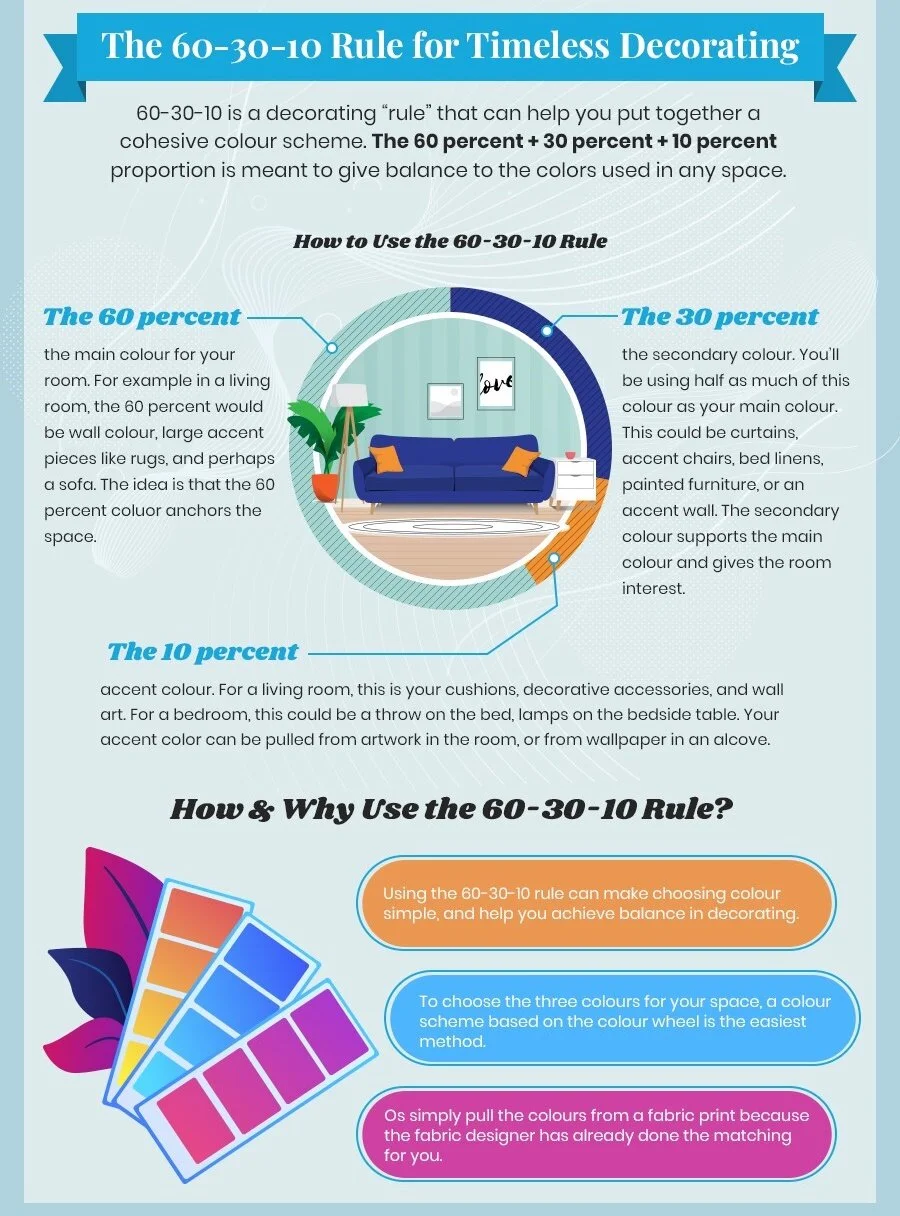
Before we go there though; that is, into how specific colors affect moods, emotions, and comfort levels in the spaces they’re used, we found ourselves attracted to their 60-30-10 Colour Rule for Timeless Decorating.

room color in design

As they explain, the Rule is designed to ensure the colors used in any space are in proportion, and that they offer balance when used this way. The breakdown makes sense, with the Main color (60%), Secondary color (30%), and the Accent color (10%).

  • Main color – In a living room, for example, this would include wall color, rugs and/or carpeting, as well as the central piece of furniture, perhaps a sofa or sectional (which are making a huge comeback, BTW). This way, your 60% color becomes the foundational emphasis of the space.

  • Secondary color – Use half as much of this color, relative to your Main color. Choices for your Secondary color here include curtains, accent chairs, painted furniture, bed linens, or an accent wall. The choices you make with this color will enhance and support your Main color while keeping the space interesting and distinct.

  • Accent colors – Using a living room again, your 10% color may be found on lamps, cushions, accessories, and wall art. In a bedroom, this might be accented with a throw on the bed, lamps, and decorative pillows and comforters. Again, your goal with Accent colors is to make a space unique, and uniquely balanced, in color choices.

Balance… Comfort… Pleasure… Belonging… Home… These are the qualities a homeowner seeks from their interior designer. The balanced use of color in each space makes all of them possible for you to give them.

Psychological Impact of Colors

While the majority of human beings have an intuitive understanding of the power of colors to affect moods, many researchers refuse to accept intuition or anecdotal evidence as proof (of anything). They want data and, for them, skepticism reigns supreme.

 However, according to an article on the mental health website Very Well Mind, “While perceptions of color are somewhat subjective, there are some color effects that have universal meaning.

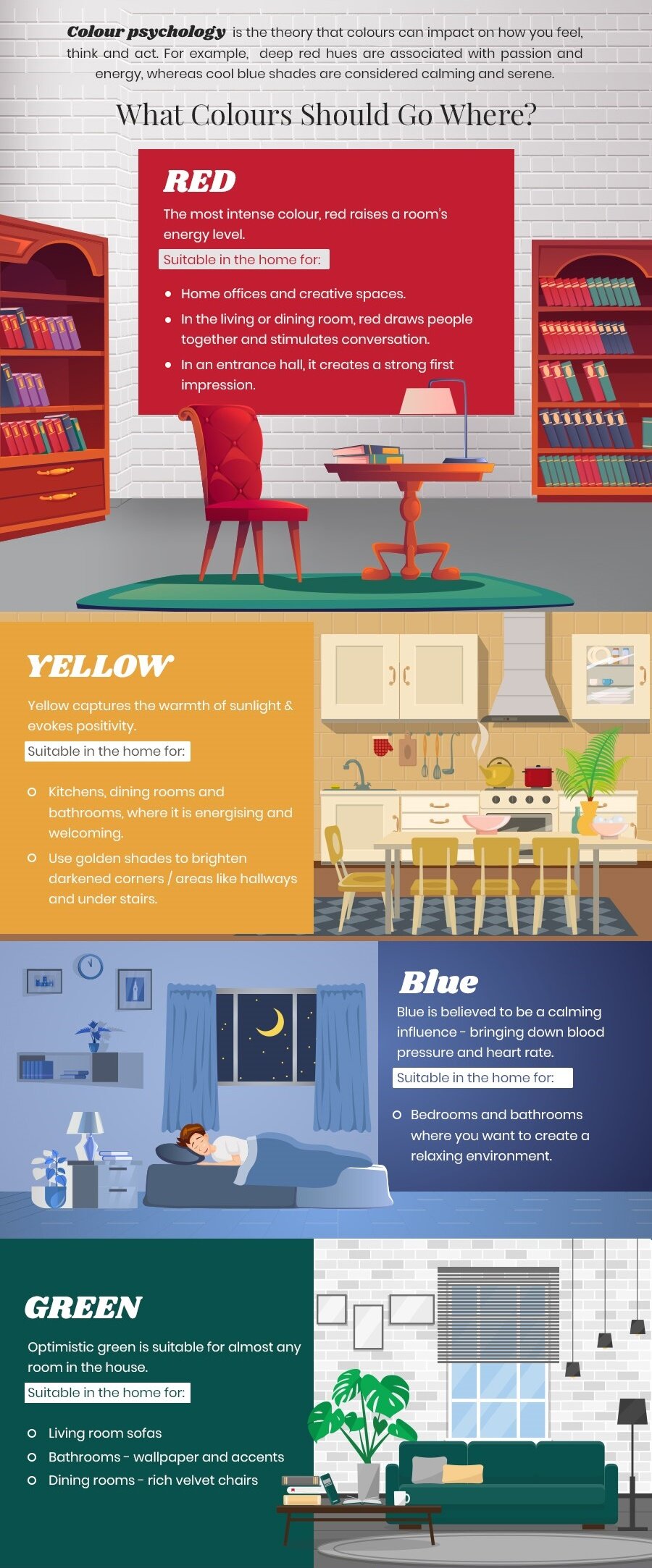
“Colors in the red area of the color spectrum are known as warm colors and include red, orange, and yellow. These warm colors evoke emotions ranging from feelings of warmth and comfort to feelings of anger and hostility.

“Colors on the blue side of the spectrum are known as cool colors and include blue, purple, and green. These colors are often described as calm, but can also call to mind feelings of sadness or indifference.”

Does Proof Exist?

psychology of color

As an interior designer, whether through intuition or education, you likely understand the emotional impact of colors in rooms and furnishings. For example, and from Very Well Mind again, “The connection between colors and emotions have established color choice as a kind of science. Environmental psychologist Lee Chambers, PsyM says that color associations are extremely important, even in workplaces.

“He explains, ‘I explore how color can be used to promote productivity and well-being in a work environment. From a psychological perspective, it is clear that an individual's cultural appreciation of color and personal preference can influence the effect of the color on their mood.’

“From a psychological perspective, it is clear that an individual's cultural appreciation of color and personal preference can influence the effect of the color on their mood.

“It makes sense that red can provoke positive and negative emotions since it signifies love and passion, as well as danger and anger. Based on his observations, Chambers reports, ‘A red environment was highly stimulating and created a level of energy which increased agitation and volatility, leaving one employee referencing the fact that the red wall made him feel aggressive’.

“Chambers also reports that yellow can boost creativity and learning, but fatigue the eyes after a while. He also explains that shades of green are common in his work. ‘Green environments are a large part of my work and encompassing nature in the workplace is a significant driver. We can see more shades of green than any other color.’ This is most likely because of the reported feeling of growth and regeneration.”

While the mood-altering effects of color may be temporary, our intuitive understanding of the power of colors to affect our moods cannot be denied. When you add personal experience to that, the negative evaluations of the so-called “experts” quickly fades.

Ted remains available to work with you on an individual basis, consulting on how your design business can best employ the psychological impact of room color in design to make your clients happy. Get in touch with TD Fall today.